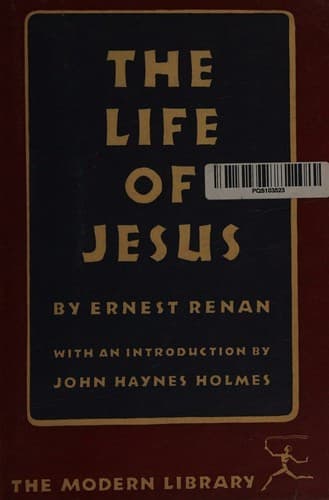
Christian biography -- Palestine; Jesus Christ -- Biography
We suppose that this last phase of the activity of Jesus continued
about eighteen months from the time of his return from the Passover of
the year 31, until his journey to the feast of tabernacles of the year
32.[1] During this time, the mind of Jesus does not appear to have
been enriched by the addition of any new element; but all his old
ideas grew and developed with an ever-increasing degree of power and
boldness.
[Footnote 1: John v. 1, vii. 2. We follow the system of John,
according to whom the public life of Jesus lasted three years. The
synoptics, on the contrary, group all the facts within the space of
one year.]
The fundamental idea of Jesus from the beginning, was the
establishment of the kingdom of God. But this kingdom of God, as we
have already said, appears to have been understood by Jesus in very
different senses. At times, we should take him for a democratic leader
desiring only the triumph of the poor and the disinherited. At other
times, the kingdom of God is the literal accomplishment of the
apocalyptic visions of Daniel and Enoch. Lastly, the kingdom of God is
often a spiritual kingdom, and the approaching deliverance is a
deliverance of the spirit. In this last sense the revolution desired
by Jesus was the one which has really taken place; the establishment
of a new worship, purer than that of Moses. All these thoughts appear
to have existed at the same time in the mind of Jesus. The first one,
however--that of a temporal revolution--does not appear to have
impressed him much; he never regarded the earth or the riches of the
earth, or material power, as worth caring for. He had no worldly
ambition. Sometimes by a natural consequence, his great religious
importance was in danger of being converted into mere social
importance. Men came requesting him to judge and arbitrate on
questions affecting their material interests. Jesus rejected these
proposals with haughtiness, treating them as insults.[1] Full of his
heavenly ideal, he never abandoned his disdainful poverty. As to the
other two conceptions of the kingdom of God, Jesus appears always to
have held them simultaneously. If he had been only an enthusiast, led
away by the apocalypses on which the popular imagination fed, he would
have remained an obscure sectary, inferior to those whose ideas he
followed. If he had been only a puritan, a sort of Channing or
"Savoyard vicar," he would undoubtedly have been unsuccessful. The two
parts of his system, or, rather, his two conceptions of the kingdom of
God, rest one on the other, and this mutual support has been the cause
of his incomparable success. The first Christians were dreamers,
living in a circle of ideas which we should term visionary; but, at
the same time, they were the heroes of that social war which has
resulted in the enfranchisement of the conscience, and in the
establishment of a religion from which the pure worship, proclaimed by
the founder, will eventually proceed.
[Footnote 1: Luke xii. 13, 14.]
Public-domain text, read in full here on John Shaqi.
Reviews
Reviews
No reviews yet
Be the first to share your thoughts on this work.
Elsewhere in the archive
Join the Discussion
Join the discussion
Sign in to leave a comment or review.
Sign InorCreate an account