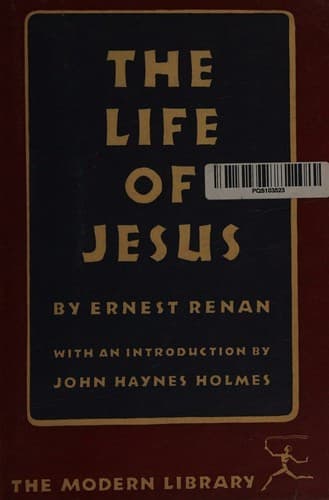
Christian biography -- Palestine; Jesus Christ -- Biography
That all this was taken literally by the disciples and by the master
himself at certain moments, appears clearly evident from the writings
of the time. If the first Christian generation had one profound and
constant belief, it was that the world was near its end,[1] and that
the great "revelation"[2] of Christ was about to take place. The
startling proclamation, "The time is at hand,"[3] which commences and
closes the Apocalypse; the incessantly reiterated appeal, "He that
hath ears to hear let him hear!"[4] were the cries of hope and
encouragement for the whole apostolic age. A Syrian expression, _Maran
atha_, "Our Lord cometh!"[5] became a sort of password, which the
believers used amongst themselves to strengthen their faith and their
hope. The Apocalypse, written in the year 68 of our era,[6] declares
that the end will come in three years and a half.[7] The "Ascension of
Isaiah"[8] adopts a calculation very similar to this.
[Footnote 1: _Acts_ ii. 17, iii. 19, and following; 1 _Cor._ xv. 23,
24, 52; 1 Thess. iii. 13, iv. 14, and following, v. 23; 2 Thess. ii.
8; 1 Tim. vi. 14; 2 Tim. iv. 1; Tit. ii. 13; Epistle of James v. 3, 8;
Epistle of Jude 18; 2d Epistle of Peter, iii. entirely; _Revelations_
entirely, and in particular, i. 1, ii. 5, 16, iii. 11, xi. 14, xxii.
6, 7, 12, 20. Comp. 4th Book of Esdras, iv. 26.]
[Footnote 2: Luke xvii. 30; 1 _Cor._ i. 7, 8; 2 Thess. i. 7; 1 Peter
i. 7, 13; _Revelations_ i. 1.]
[Footnote 3: _Revelations_ i. 3, xxii. 10.]
[Footnote 4: Matt. xi. 15, xiii. 9, 43; Mark iv. 9, 23, vii. 16; Luke
viii. 8, xiv. 35; _Revelations_ ii. 7, 11, 27, 29, iii. 6, 13, 22,
xiii. 9.]
[Footnote 5: 1 _Cor._ xvi. 22.]
[Footnote 6: _Revelations_ xvii. 9, and following. The sixth emperor,
whom the author represents as reigning, is Galba. The dead emperor,
who was to return, is Nero, whose name is given in figures (xiii.
18).]
[Footnote 7: _Revelations_ xi. 2, 3, xii. 14. Comp. Daniel vii. 25,
xii. 7.]
[Footnote 8: Chap. iv., v. 12 and 14. Comp. Cedrenus, p. 68 (Paris,
1647).]
Public-domain text, read in full here on John Shaqi.
Reviews
Reviews
No reviews yet
Be the first to share your thoughts on this work.
Elsewhere in the archive
Join the Discussion
Join the discussion
Sign in to leave a comment or review.
Sign InorCreate an account