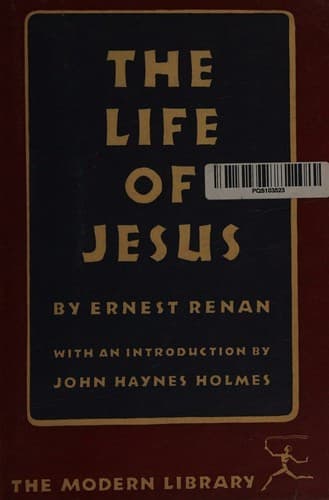
Christian biography -- Palestine; Jesus Christ -- Biography
These formal declarations preoccupied the Christian family for nearly
seventy years. It was believed that some of the disciples would see
the day of the final revelation before dying. John, in particular, was
considered as being of this number;[1] many believed that he would
never die. Perhaps this was a later opinion suggested toward the end
of the first century, by the advanced age which John seems to have
reached; this age having given rise to the belief that God wished to
prolong his life indefinitely until the great day, in order to realize
the words of Jesus. However this may be, at his death the faith of
many was shaken, and his disciples attached to the prediction of
Christ a more subdued meaning.[2]
[Footnote 1: John xxi. 22, 23.]
[Footnote 2: John xxi. 22, 23. Chapter xxi. of the fourth Gospel is an
addition, as is proved by the final clause of the primitive
compilation, which concludes at verse 31 of chapter xx. But the
addition is almost contemporaneous with the publication of the Gospel
itself.]
At the same time that Jesus fully admitted the Apocalyptic beliefs,
such as we find them in the apocryphal Jewish books, he admitted the
doctrine, which is the complement, or rather the condition of them
all, namely, the resurrection of the dead. This doctrine, as we have
already said, was still somewhat new in Israel; a number of people
either did not know it, or did not believe it.[1] It was the faith of
the Pharisees, and of the fervent adherents of the Messianic
beliefs.[2] Jesus accepted it unreservedly, but always in the most
idealistic sense. Many imagined that in the resuscitated world they
would eat, drink, and marry. Jesus, indeed, admits into his kingdom a
new passover, a table, and a new wine;[3] but he expressly excludes
marriage from it. The Sadducees had on this subject an apparently
coarse argument, but one which was really in conformity with the old
theology. It will be remembered that according to the ancient sages,
man survived only in his children. The Mosaic code had consecrated
this patriarchal theory by a strange institution, the levirate law.
The Sadducees drew from thence subtle deductions against the
resurrection. Jesus escaped them by formally declaring that in the
life eternal there would no longer exist differences of sex, and that
men would be like the angels.[4] Sometimes he seems to promise
resurrection only to the righteous,[5] the punishment of the wicked
consisting in complete annihilation.[6] Oftener, however, Jesus
declares that the resurrection shall bring eternal confusion to the
wicked.[7]
[Footnote 1: Mark ix. 9; Luke xx. 27, and following.]
[Footnote 2: Dan. xii. 2, and following; 2 Macc. vii. entirely, xii.
45, 46, xiv. 46; _Acts_ xxiii. 6, 8; Jos., _Ant._, XVIII. i. 3;
_B.J._, II. viii. 14, III. viii. 5.]
[Footnote 3: Matt. xxvi. 29; Luke xxii. 30.]
Public-domain text, read in full here on John Shaqi.
Reviews
Reviews
No reviews yet
Be the first to share your thoughts on this work.
Elsewhere in the archive
Join the Discussion
Join the discussion
Sign in to leave a comment or review.
Sign InorCreate an account