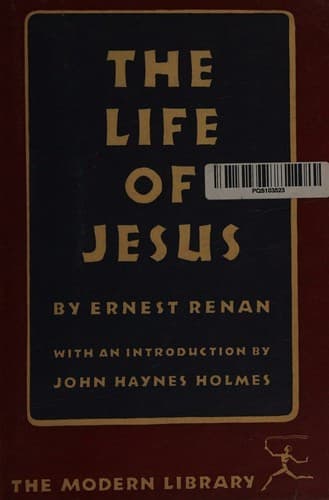
Christian biography -- Palestine; Jesus Christ -- Biography
Let us not, however, despise this chimera, which has been the thick
rind of the sacred fruit on which we live. This fantastic kingdom of
heaven, this endless pursuit after a city of God, which has constantly
preoccupied Christianity during its long career, has been the
principle of that great instinct of futurity which has animated all
reformers, persistent believers in the Apocalypse, from Joachim of
Flora down to the Protestant sectary of our days. This impotent effort
to establish a perfect society has been the source of the
extraordinary tension which has always made the true Christian an
athlete struggling against the existing order of things. The idea of
the "kingdom of God," and the Apocalypse, which is the complete image
of it, are thus, in a sense, the highest and most poetic expressions
of human progress. But they have necessarily given rise to great
errors. The end of the world, suspended as a perpetual menace over
mankind, was, by the periodical panics which it caused during
centuries, a great hindrance to all secular development. Society
being no longer certain of its existence, contracted therefrom a
degree of trepidation, and those habits of servile humility, which
rendered the Middle Ages so inferior to ancient and modern times.[1] A
profound change had also taken place in the mode of regarding the
coming of Christ. When it was first announced to mankind that the end
of the world was about to come, like the infant which receives death
with a smile, it experienced the greatest access of joy that it has
ever felt. But in growing old, the world became attached to life. The
day of grace, so long expected by the simple souls of Galilee, became
to these iron ages a day of wrath: _Dies irae, dies illa!_ But, even in
the midst of barbarism, the idea of the kingdom of God continued
fruitful. In spite of the feudal church, of sects, and of religious
orders, holy persons continued to protest, in the name of the Gospel,
against the iniquity of the world. Even in our days, troubled days, in
which Jesus has no more authentic followers than those who seem to
deny him, the dreams of an ideal organization of society, which have
so much analogy with the aspirations of the primitive Christian sects,
are only in one sense the blossoming of the same idea. They are one of
the branches of that immense tree in which germinates all thought of a
future, and of which the "kingdom of God" will be eternally the root
and stem. All the social revolutions of humanity will be grafted on
this phrase. But, tainted by a coarse materialism, and aspiring to the
impossible, that is to say, to found universal happiness upon
political and economical measures, the "socialist" attempts of our
time will remain unfruitful until they take as their rule the true
spirit of Jesus, I mean absolute idealism--the principle that, in
order to possess the world, we must renounce it.
Public-domain text, read in full here on John Shaqi.
Reviews
Reviews
No reviews yet
Be the first to share your thoughts on this work.
Elsewhere in the archive
Join the Discussion
Join the discussion
Sign in to leave a comment or review.
Sign InorCreate an account