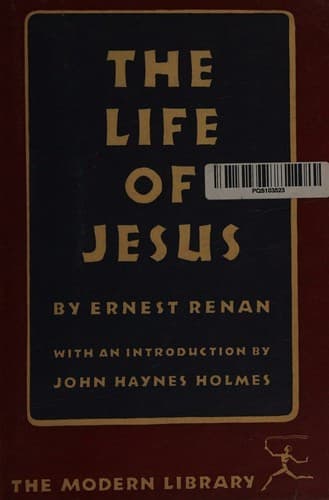
Christian biography -- Palestine; Jesus Christ -- Biography
Never, we perceive, would this primitive Church have formed a lasting
society but for the great variety of germs deposited by Jesus in his
teaching. It required more than a century for the true Christian
Church--that which has converted the world--to disengage itself from
this little sect of "latter-day saints," and to become a framework
applicable to the whole of human society. The same thing, indeed, took
place in Buddhism, which at first was founded only for monks. The same
thing would have happened in the order of St. Francis, if that order
had succeeded in its pretension of becoming the rule of the whole of
human society. Essentially Utopian in their origin, and succeeding by
their very exaggeration, the great systems of which we have just
spoken have only laid hold of the world by being profoundly modified,
and by abandoning their excesses. Jesus did not advance beyond this
first and entirely monachal period, in which it was believed that the
impossible could be attempted with impunity. He made no concession to
necessity. He boldly preached war against nature, and total severance
from ties of blood. "Verily I say unto you," said he, "there is no man
that hath left house, or parents, or brethren, or wife, or children,
for the kingdom of God's sake, who shall not receive manifold more in
this present time, and in the world to come life everlasting."[1]
[Footnote 1: Luke xviii. 20, 30.]
The teachings which Jesus is reputed to have given to his disciples
breathe the same exaltation.[1] He who was so tolerant to the world
outside, he who contented himself sometimes with half adhesions,[2]
exercised toward his own an extreme rigor. He would have no "all
buts." We should call it an "order," constituted by the most austere
rules. Faithful to his idea that the cares of life trouble man, and
draw him downward, Jesus required from his associates a complete
detachment from the earth, an absolute devotion to his work. They were
not to carry with them either money or provisions for the way, not
even a scrip, or change of raiment. They must practise absolute
poverty, live on alms and hospitality. "Freely ye have received,
freely give,"[3] said he, in his beautiful language. Arrested and
arraigned before the judges, they were not to prepare their defence;
the _Peraklit_, the heavenly advocate, would inspire them with what
they ought to say. The Father would send them his Spirit from on high,
which would become the principle of all their acts, the director of
their thoughts, and their guide through the world.[4] If driven from
any town, they were to shake the dust from their shoes, declaring
always the proximity of the kingdom of God, that none might plead
ignorance. "Ye shall not have gone over the cities of Israel," added
he, "till the Son of man be come."
Public-domain text, read in full here on John Shaqi.
Reviews
Reviews
No reviews yet
Be the first to share your thoughts on this work.
Elsewhere in the archive
Join the Discussion
Join the discussion
Sign in to leave a comment or review.
Sign InorCreate an account