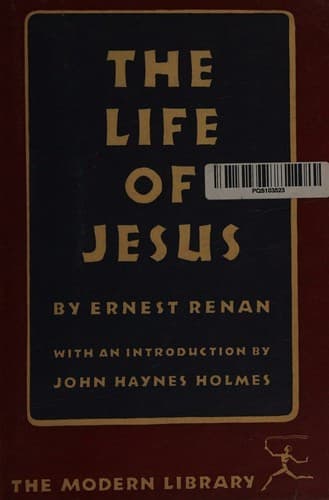
Christian biography -- Palestine; Jesus Christ -- Biography
A great danger threatened the future of this exalted morality, thus
expressed in hyperbolical language and with a terrible energy. By
detaching man from earth the ties of life were severed. The Christian
would be praised for being a bad son, or a bad patriot, if it was for
Christ that he resisted his father and fought against his country. The
ancient city, the parent republic, the state, or the law common to
all, were thus placed in hostility with the kingdom of God. A fatal
germ of theocracy was introduced into the world.
From this point, another consequence may be perceived. This morality,
created for a temporary crisis, when introduced into a peaceful
country, and in the midst of a society assured of its own duration,
must seem impossible. The Gospel was thus destined to become a Utopia
for Christians, which few would care to realize. These terrible maxims
would, for the greater number, remain in profound oblivion, an
oblivion encouraged by the clergy itself; the Gospel man would prove a
dangerous man. The most selfish, proud, hard and worldly of all human
beings, a Louis XIV. for instance, would find priests to persuade him,
in spite of the Gospel, that he was a Christian. But, on the other
hand, there would always be found holy men who would take the sublime
paradoxes of Jesus literally. Perfection being placed beyond the
ordinary conditions of society, and a complete Gospel life being only
possible away from the world, the principle of asceticism and of
monasticism was established. Christian societies would have two moral
rules; the one moderately heroic for common men, the other exalted in
the extreme for the perfect man; and the perfect man would be the
monk, subjected to rules which professed to realize the gospel ideal.
It is certain that this ideal, if only on account of the celibacy and
poverty it imposed, could not become the common law. The monk would be
thus, in one sense, the only true Christian. Common sense revolts at
these excesses; and if we are guided by it, to demand the impossible,
is a mark of weakness and error. But common sense is a bad judge where
great matters are in question. To obtain little from humanity we must
ask much. The immense moral progress which we owe to the Gospel is the
result of its exaggerations. It is thus that it has been, like
stoicism, but with infinitely greater fulness, a living argument for
the divine powers in man, an exalted monument of the potency of the
will.
Public-domain text, read in full here on John Shaqi.
Reviews
Reviews
No reviews yet
Be the first to share your thoughts on this work.
Elsewhere in the archive
Join the Discussion
Join the discussion
Sign in to leave a comment or review.
Sign InorCreate an account