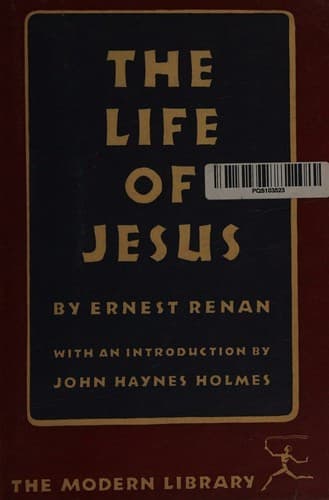
Christian biography -- Palestine; Jesus Christ -- Biography
To know that we have touched the ideal
for a moment, and have been deterred by the wickedness of a few, is a
thought insupportable to an ardent soul. What must it have been for
the founder of a new world?
[Footnote 1: Matt. xii. 34, xv. 14, xxiii. 33.]
[Footnote 2: Matt. iii. 7.]
[Footnote 3: Matt. xii. 30; Luke xxi. 23.]
[Footnote 4: Isa. xlii. 2, 3.]
[Footnote 5: Matt. xii. 19-20.]
[Footnote 6: Matt. x. 14, 15, 21, and following, 34, and following;
Luke xix. 27.]
The invincible obstacle to the ideas of Jesus came especially from
orthodox Judaism, represented by the Pharisees. Jesus became more and
more alienated from the ancient Law. Now, the Pharisees were the true
Jews; the nerve and sinew of Judaism. Although this party had its
centre at Jerusalem, it had adherents either established in Galilee,
or who often came there.[1] They were, in general, men of a narrow
mind, caring much for externals; their devoutness was haughty, formal,
and self-satisfied.[2] Their manners were ridiculous, and excited the
smiles of even those who respected them. The epithets which the people
gave them, and which savor of caricature, prove this. There was the
"bandy-legged Pharisee" (_Nikfi_), who walked in the streets dragging
his feet and knocking them against the stones; the "bloody-browed
Pharisee" (_Kizai_), who went with his eyes shut in order not to see
the women, and dashed his head so much against the walls that it was
always bloody; the "pestle Pharisee" (_Medinkia_), who kept himself
bent double like the handle of a pestle; the "Pharisee of strong
shoulders" (_Shikmi_), who walked with his back bent as if he carried
on his shoulders the whole burden of the Law; the
"_What-is-there-to-do?-I-do-it Pharisee_," always on the search for a
precept to fulfil; and, lastly, the "dyed Pharisee," whose externals
of devotion were but a varnish of hypocrisy.[3] This strictness was,
in fact, often only apparent, and concealed in reality great moral
laxity.[4] The people, nevertheless, were duped by it. The people,
whose instinct is always right, even when it is most astray respecting
individuals, is very easily deceived by false devotees. That which it
loves in them is good and worthy of being loved; but it has not
sufficient penetration to distinguish the appearance from the reality.
[Footnote 1: Mark vii. 1; Luke v. 17, and following, vii. 36.]
[Footnote 2: Matt. vi. 2, 5, 16, ix. 11, 14, xii. 2, xxiii. 5, 15, 23;
Luke v. 30, vi. 2, 7, xi. 39, and following, xviii. 12; John ix. 16;
_Pirke Aboth_, i. 16; Jos., _Ant._, XVII. ii. 4, XVIII. i. 3; _Vita_,
38; Talm. of Bab., _Sota_, 22 _b_.]
Public-domain text, read in full here on John Shaqi.
Reviews
Reviews
No reviews yet
Be the first to share your thoughts on this work.
Elsewhere in the archive
Join the Discussion
Join the discussion
Sign in to leave a comment or review.
Sign InorCreate an account