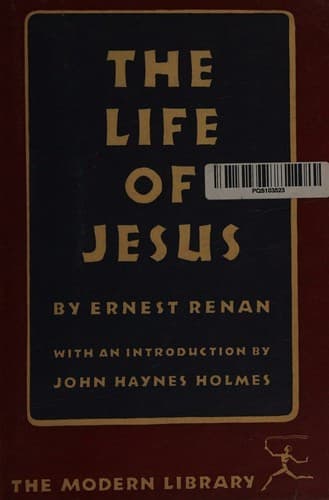
Christian biography -- Palestine; Jesus Christ -- Biography
His teaching in this new world necessarily became much modified. His
beautiful discourses, the effect of which was always observable upon
youthful imaginations and consciences morally pure, here fell upon
stone. He who was so much at his ease on the shores of his charming
little lake, felt constrained and not at home in the company of
pedants. His perpetual self-assertion appeared somewhat fastidious.[1]
He was obliged to become controversialist, jurist, exegetist, and
theologian. His conversations, generally so full of charm, became a
rolling fire of disputes,[2] an interminable train of scholastic
battles. His harmonious genius was wasted in insipid argumentations
upon the Law and the prophets,[3] in which we should have preferred
not seeing him sometimes play the part of aggressor.[4] He lent
himself with a condescension we cannot but regret to the captious
criticisms to which the merciless cavillers subjected him.[5] In
general, he extricated himself from difficulties with much skill. His
reasonings, it is true, were often subtle (simplicity of mind and
subtlety touch each other; when simplicity reasons, it is often a
little sophistical); we find that sometimes he courted misconceptions,
and prolonged them intentionally;[6] his reasoning, judged according
to the rules of Aristotelian logic, was very weak. But when the
unequaled charm of his mind could be displayed, he was triumphant. One
day it was intended to embarrass him by presenting to him an
adulteress and asking him what was to be done to her. We know the
admirable answer of Jesus.[7] The fine raillery of a man of the
world, tempered by a divine goodness, could not be expressed in a more
exquisite manner. But the wit which is allied to moral grandeur is
that which fools forgive the least. In pronouncing this sentence of so
just and pure a taste: "He that is without sin among you, let him
first cast a stone at her," Jesus pierced hypocrisy to the heart, and
with the same stroke sealed his own death-warrant.
[Footnote 1: John viii. 13, and following.]
[Footnote 2: Matt. xxi. 23-37.]
[Footnote 3: Matt. xxii. 23, and following.]
[Footnote 4: Matt. xxii. 42, and following.]
[Footnote 5: Matt. xxii. 36, and following, 46.]
[Footnote 6: See especially the discussions reported by John, chapter
viii., for example; it is true that the authenticity of such passages
is only relative.]
[Footnote 7: John viii. 3, and following. This passage did not at
first form part of the Gospel of St. John; it is wanting in the more
ancient manuscripts, and the text is rather unsettled. Nevertheless,
it is from the primitive Gospel traditions, as is proved by the
singular peculiarities of verses 6 and 8, which are not in the style
of Luke, and compilers at second hand, who admitted nothing that does
not explain itself. This history is found, as it seems, in the Gospel
according to the Hebrews. (Papias, quoted by Eusebius, _Hist. Eccl._,
iii. 39.)]
Public-domain text, read in full here on John Shaqi.
Reviews
Reviews
No reviews yet
Be the first to share your thoughts on this work.
Elsewhere in the archive
Join the Discussion
Join the discussion
Sign in to leave a comment or review.
Sign InorCreate an account