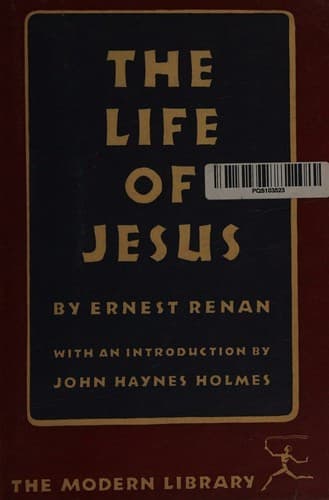
Christian biography -- Palestine; Jesus Christ -- Biography
a mere creation of the popular mind could exist in a collection of
remembrances so entirely personal. It is, then, probable that the
miracle in question was not one of those purely legendary ones for
which no one is responsible. In other words, we think that something
really happened at Bethany which was looked upon as a resurrection.
[Footnote 1: John xi. 1, and following.]
Fame already attributed to Jesus two or three works of this kind.[1]
The family of Bethany might be led, almost without suspecting it, into
taking part in the important act which was desired. Jesus was adored
by them. It seems that Lazarus was sick, and that in consequence of
receiving a message from the anxious sisters Jesus left Perea.[2] They
thought that the joy Lazarus would feel at his arrival might restore
him to life. Perhaps, also, the ardent desire of silencing those who
violently denied the divine mission of Jesus, carried his enthusiastic
friends beyond all bounds. It may be that Lazarus, still pallid with
disease, caused himself to be wrapped in bandages as if dead, and shut
up in the tomb of his family. These tombs were large vaults cut in
the rock, and were entered by a square opening, closed by an enormous
stone. Martha and Mary went to meet Jesus, and without allowing him to
enter Bethany, conducted him to the cave. The emotion which Jesus
experienced at the tomb of his friend, whom he believed to be dead,[3]
might be taken by those present for the agitation and trembling[4]
which accompanied miracles. Popular opinion required that the divine
virtue should manifest itself in man as an epileptic and convulsive
principle. Jesus (if we follow the above hypothesis) desired to see
once more him whom he had loved; and, the stone being removed, Lazarus
came forth in his bandages, his head covered with a winding-sheet.
This reappearance would naturally be regarded by every one as a
resurrection. Faith knows no other law than the interest of that which
it believes to be true. Regarding the object which it pursues as
absolutely holy, it makes no scruple of invoking bad arguments in
support of its thesis when good ones do not succeed. If such and such
a proof be not sound many others are! If such and such a wonder be not
real, many others have been! Being intimately persuaded that Jesus was
a thaumaturgus, Lazarus and his two sisters may have aided in the
execution of one of his miracles, just as many pious men who,
convinced of the truth of their religion, have sought to triumph over
the obstinacy of their opponents by means of whose weakness they were
well aware. The state of their conscience was that of the stigmatists,
of the convulsionists, of the possessed ones in convents, drawn, by
the influence of the world in which they live, and by their own
belief, into feigned acts. As to Jesus, he was no more able than St.
Bernard or St. Francis d'Assisi to moderate the avidity for the
marvellous, displayed by the multitude, and even by his own disciples.
Public-domain text, read in full here on John Shaqi.
Reviews
Reviews
No reviews yet
Be the first to share your thoughts on this work.
Elsewhere in the archive
Join the Discussion
Join the discussion
Sign in to leave a comment or review.
Sign InorCreate an account