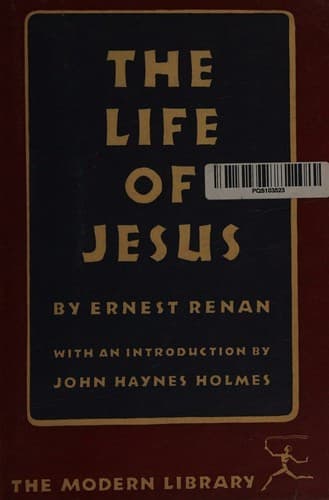
Christian biography -- Palestine; Jesus Christ -- Biography
This personage was Hanan or Annas,[1] son of Seth, and father-in-law
of Kaiapha. He was formerly the high priest, and had in reality
preserved amidst the numerous changes of the pontificate all the
authority of the office. He had received the high priesthood from the
legate Quirinius, in the year 7 of our era. He lost his office in the
year 14, on the accession of Tiberius; but he remained much respected.
He was still called "high priest," although he was out of office,[2]
and he was consulted upon all important matters. During fifty years
the pontificate continued in his family almost uninterruptedly; five
of his sons successively sustained this dignity,[3] besides Kaiapha,
who was his son-in-law. His was called the "priestly family," as if
the priesthood had become hereditary in it.[4] The chief offices of
the temple were almost all filled by them.[5] Another family, that of
Boethus, alternated, it is true, with that of Hanan's in the
pontificate.[6] But the _Boethusim_, whose fortunes were of not very
honorable origin, were much less esteemed by the pious middle class.
Hanan was then in reality the chief of the priestly party. Kaiapha did
nothing without him; it was customary to associate their names, and
that of Hanan was always put first.[7] It will be understood, in fact,
that under this _regime_ of an annual pontificate, changed according
to the caprice of the procurators, an old high priest, who had
preserved the secret of the traditions, who had seen many younger than
himself succeed each other, and who had retained sufficient influence
to get the office delegated to persons who were subordinate to him in
family rank, must have been a very important personage. Like all the
aristocracy of the temple,[8] he was a Sadducee, "a sect," says
Josephus, "particularly severe in its judgments." All his sons also
were violent persecutors.[9] One of them, named like his father,
Hanan, caused James, the brother of the Lord, to be stoned, under
circumstances not unlike those which surrounded the death of Jesus.
The spirit of the family was haughty, bold, and cruel;[10] it had that
particular kind of proud and sullen wickedness which characterizes
Jewish politicians. Therefore, upon this Hanan and his family must
rest the responsibility of all the acts which followed. It was Hanan
(or the party he represented) who killed Jesus. Hanan was the
principal actor in the terrible drama, and far more than Kaiapha, far
more than Pilate, ought to bear the weight of the maledictions of
mankind.
[Footnote 1: The _Ananus_ of Josephus. It is thus that the Hebrew name
_Johanan_ became in Greek _Joannes_ or _Joannas_.]
[Footnote 2: John xviii. 15-23; _Acts_ iv. 6.]
[Footnote 3: Jos., _Ant._, XX. ix. 1.]
[Footnote 4: Jos., _Ant._, XV. iii. 1; _B.J._, IV. v. 6 and 7; _Acts_
iv. 6.]
[Footnote 5: Jos., _Ant._, XX. ix. 3.]
[Footnote 6: Jos., _Ant._, XV. ix. 3, XIX. vi. 2, viii. 1.]
[Footnote 7: Luke iii. 2.]
[Footnote 8: _Acts_ v. 17.]
Public-domain text, read in full here on John Shaqi.
Reviews
Reviews
No reviews yet
Be the first to share your thoughts on this work.
Elsewhere in the archive
Join the Discussion
Join the discussion
Sign in to leave a comment or review.
Sign InorCreate an account