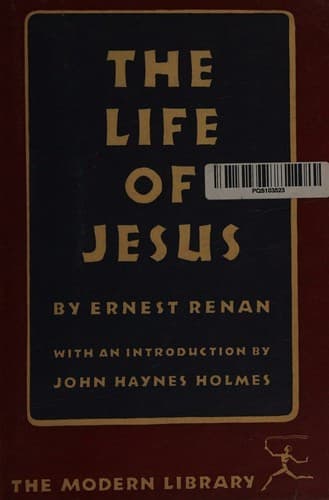
Christian biography -- Palestine; Jesus Christ -- Biography
Preserve us, then, from mutilating history in order to satisfy our
petty susceptibilities! Which of us, pigmies as we are, could do what
the extravagant Francis d'Assisi, or the hysterical saint Theresa, has
done? Let medicine have names to express these grand errors of human
nature; let it maintain that genius is a disease of the brain; let it
see, in a certain delicacy of morality, the commencement of
consumption; let it class enthusiasm and love as nervous
accidents--it matters little. The terms healthy and diseased are
entirely relative. Who would not prefer to be diseased like Pascal,
rather than healthy like the common herd? The narrow ideas which are
spread in our times respecting madness, mislead our historical
judgments in the most serious manner, in questions of this kind. A
state in which a man says things of which he is not conscious, in
which thought is produced without the summons and control of the will,
exposes him to being confined as a lunatic. Formerly this was called
prophecy and inspiration. The most beautiful things in the world are
done in a state of fever; every great creation involves a breach of
equilibrium, a violent state of the being which draws it forth.
We acknowledge, indeed, that Christianity is too complex to have been
the work of a single man. In one sense, entire humanity has
co-operated therein. There is no one so shut in, as not to receive
some influence from without. The history of the human mind is full of
strange coincidences, which cause very remote portions of the human
species, without any communication with each other, to arrive at the
same time at almost identical ideas and imaginations. In the
thirteenth century, the Latins, the Greeks, the Syrians, the Jews, and
the Mussulmans, adopted scholasticism, and very nearly the same
scholasticism from York to Samarcand; in the fourteenth century every
one in Italy, Persia, and India, yielded to the taste for mystical
allegory; in the sixteenth, art was developed in a very similar manner
in Italy, at Mount Athos, and at the court of the Great Moguls,
without St. Thomas, Barhebraeus, the Rabbis of Narbonne, or the
_Motecallemin_ of Bagdad, having known each other, without Dante and
Petrarch having seen any _sofi_, without any pupil of the schools of
Perouse or of Florence having been at Delhi. We should say there are
great moral influences running through the world like epidemics,
without distinction of frontier and of race. The interchange of ideas
in the human species does not take place only by books or by direct
instruction. Jesus was ignorant of the very name of Buddha, of
Zoroaster, and of Plato; he had read no Greek book, no Buddhist Sudra;
nevertheless, there was in him more than one element, which, without
his suspecting it, came from Buddhism, Parseeism, or from the Greek
wisdom. All this was done through secret channels and by that kind of
sympathy which exists among the various portions of humanity. The
Public-domain text, read in full here on John Shaqi.
Reviews
Reviews
No reviews yet
Be the first to share your thoughts on this work.
Elsewhere in the archive
Join the Discussion
Join the discussion
Sign in to leave a comment or review.
Sign InorCreate an account