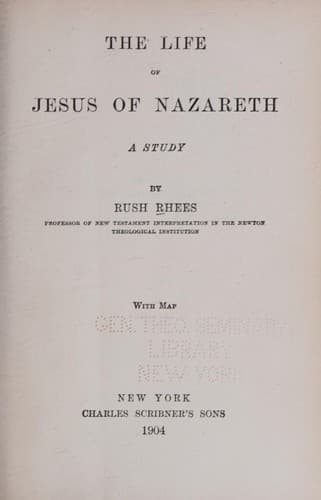
235. Nothing in the teaching of Jesus is more remarkable than his
confidence that men who believed in him would adequately represent him and
his message to the world. The parable of the Leaven seems to have set
forth his own method. We owe our gospels to no injunction given by him to
write down what he said and did. He impressed himself on his followers,
filled them with a love to himself which made them sensitive to his ideas
as a photographic plate is to light, teaching them his truth in forms that
did not at first show any effect on their thought, but were developed into
strength and clearness by the experiences of the passing years. Christian
ethics and theology are far more than an orderly presentation of the
teaching of Jesus; in so far as they are purely Christian they are the
systematic setting forth of truth involved, though not expressed, in what
he said and did in his ministry among men. His ideas were radical and
thoroughly revolutionary. His method, however, had in it all the patience
of God's working in nature, and the hidden noiseless power of an evolution
is its characteristic. Hence it was that he chose to teach some things
exclusively in figure. So great and unfamiliar a truth as the gradual
development of God's kingdom was unwelcome to the thought of his time. He
made it, therefore, the theme of many of his parables; and although the
disciples did not understand what he meant, the picture remained with
them, and in after years they grew up to his idea.
236. Jesus' use of illustration is one of the most marked features of his
teaching. In one sense this simply proves him to be a genuine Oriental,
for to contemplate and present abstract truths in concrete form is
characteristic of the Semitic mind. In the case of Jesus, however, it
proves more: the variety and homeliness of his illustrations show how
completely conversant he was alike with common life and with spiritual
truth. There is a freedom and ease about his use of figurative language
which suggests, as nothing else could, his own clear certainty concerning
the things of which he spoke. The fact, too, that his mind dealt so
naturally with the highest thoughts has made his illustrations unique for
profound truth and simple beauty. Nearly the whole range of figurative
speech is represented in his recorded words, including forms like irony
and hyperbole, often held to be unnatural to such serious speech as his.
Public-domain text, read in full here on John Shaqi.
Reviews
Reviews
No reviews yet
Be the first to share your thoughts on this work.
Elsewhere in the archive
Join the Discussion
Join the discussion
Sign in to leave a comment or review.
Sign InorCreate an account