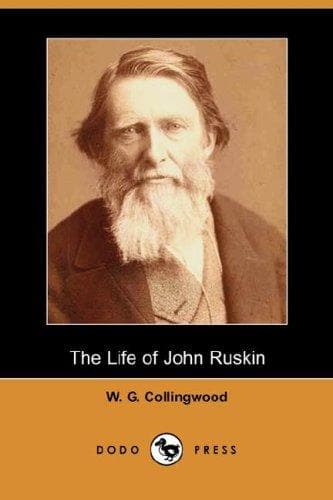
The Life of John RuskinCollingwood, W. G. (William Gershom)
Philosophy
The Life of John Ruskin
Collingwood, W. G. (William Gershom)
Authors, English -- 19th century -- Biography; Ruskin, John, 1819-1900
In spite of a "classical education" and the influence of Aristotle upon
the immature art-theories of his earlier works, Ruskin was known, in his
younger days, as a Goth, and the enemy of the Greeks. When he began
life, his sense of justice made him take the side of Modern Painters
against classical tradition. Later on, when considering the great
questions of education and the aims of life, he entirely set aside the
common routine of Greek and Latin grammar as the all-in-all of culture.
But this was not because he shared Carlyle's contempt for classical
studies.
In "Modern Painters," Vol. III., he had followed out the indications of
nature-worship, and tried to analyse in general terms the attitude of
the Greek spirit towards landscape scenery, as betrayed in Homer and
Aristophanes and the poets usually read. Since that time his interest in
Greek literature had been gradually increasing. He had made efforts to
improve his knowledge of the language; and he had spent many days in
sketching and studying the terra-cottas and vases and coins at the
British Museum. He had also taken up some study of Egyptology, through
Champollion, Bunsen and Birch, in the hope of tracing the origin of
Greek decorative art. Comparative mythology, at that time, was a
department of philology, introduced to the English public chiefly by Max
Müller. Under his influence Ruskin entered step by step upon an inquiry
which afterwards became of singular importance in his life and thought.
In 1865 he had told his hearers at Bradford that Greek Religion was not,
as commonly supposed, the worship of Beauty, but of Wisdom and Power.
They did not, in their great age, worship "Venus," but Apollo and
Athena. And he regarded their mythology as a sincere tradition,
effective in forming a high moral type, and a great school of art. In
the "Ethics of the Dust" he had explained the myth of Athena as parallel
to that of Neith in Egypt; and in his fable of Neith and St. Barbara he
had hinted at a comparison, on equal terms, of Ancient and Mediæval
mythology. He ended by saying that, though he would not have his young
hearers believe "that the Greeks were better than we, and that their
gods were real angels," yet their art and morals were in some respects
greater, and their beliefs were worth respectful and sympathetic study.
The "Queen of the Air" is his contribution to this study.
Public-domain text, read in full here on John Shaqi.
Reviews
Reviews
No reviews yet
Be the first to share your thoughts on this work.
Elsewhere in the archive
Join the Discussion
Join the discussion
Sign in to leave a comment or review.
Sign InorCreate an account