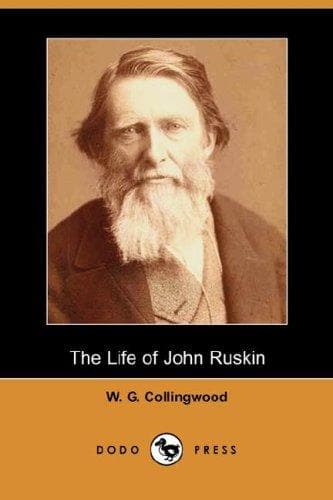
The Life of John RuskinCollingwood, W. G. (William Gershom)
Philosophy
The Life of John Ruskin
Collingwood, W. G. (William Gershom)
Authors, English -- 19th century -- Biography; Ruskin, John, 1819-1900
CHAPTER X
VERONA AND OXFORD (1869-1870)
The main object of this journey was, however, not to study mythology,
but to continue the revision of old estimates of architecture, and after
seventeen years to look with a fresh eye at the subjects of "Stones of
Venice."
The churches and monuments of Verona had been less thoroughly studied
than those of Venice, and now they were threatened with imminent
restoration. On May 25th he wrote:--"It is very strange that I have just
been in time--after 17 years' delay--to get the remainder of what I
wanted from the red tomb of which my old drawing hangs in the
passage"--(the Castelbarco monument). "To-morrow they put up scaffolding
to retouch, and I doubt not, spoil it for evermore." He succeeded in
getting a delay of ten days, to enable him to paint the tomb in its
original state; but before he went home it "had its new white cap on and
looked like a Venetian gentleman in a pantaloon's mask." He brought away
one of the actual stones of the old roof.
On June 3 he wrote:
"I am getting on well with all my own work; and much pleased with
some that Mr. Bunney is doing for me; so that really I expect to
carry off a great deal of Verona.... The only mischief of the
place is its being too rich. Stones, flowers, mountains--all
equally asking one to look at them; a history to every foot of
ground, and a picture on every foot of wall; frescoes fading away
in the neglected streets--like the colours of the dolphin."
As assistants in this enterprise of recording the monuments of Venice
and Verona, and of recording them more fully and in a more interesting
way than by photography, he took with him Arthur Burgess and John
Bunney, his former pupils. Mr. Burgess was the subject of a memoir by
Ruskin in the _Century Guild Hobby Horse_ (April, 1887), appreciating
his talents and lamenting his loss. Mr. Bunney, who had travelled with
Ruskin in Switzerland in 1863, and had lately lived near Florence,
thenceforward settled in Venice, where he died in 1882, after completing
his great work, the St. Mark's now in the Ruskin Museum at Sheffield. A
memoir of him by Mr. Wedderburn appeared in the catalogue of the Venice
Exhibition, at the Fine Art Society's Gallery in November, 1882.
At Venice Ruskin had met his old friend Rawdon Brown[17], and Count
Giberto Borromeo, whom he visited at Milan on his way home, with deep
interest in the Luinis and in the authentic bust of St. Carlo; so
closely resembling Ruskin himself. Another noteworthy encounter is
recorded in a letter of May 4th.[18]
[Footnote 17: Whose book on the English in Italy (from Venetian
documents) was shortly to be published, with funds supplied by Ruskin.]
[Footnote 18: This date ought to be "June 4th," as Mr. E.T. Cook notices
(Library Edn. XIX., p. liv.).]
Public-domain text, read in full here on John Shaqi.
Reviews
Reviews
No reviews yet
Be the first to share your thoughts on this work.
Elsewhere in the archive
Join the Discussion
Join the discussion
Sign in to leave a comment or review.
Sign InorCreate an account