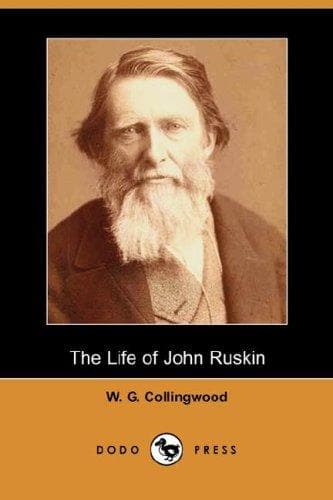
The Life of John RuskinCollingwood, W. G. (William Gershom)
Philosophy
The Life of John Ruskin
Collingwood, W. G. (William Gershom)
Authors, English -- 19th century -- Biography; Ruskin, John, 1819-1900
He had talked so much of the possibility of carrying on honest and
honourable retail trade, that he felt bound to exemplify his principles.
He took a house No. 19, Paddington Street, with a corner shop, near his
Marylebone property, and set himself up in business as a teaman. Mr.
Arthur Severn painted the sign, in neat blue letters; the window was
decked with fine old china, bought from a Cavaliere near Siena, whose
unique collection had been introduced to notice by Professor Norton; and
Miss Harrie Tovey, an old servant of Denmark Hill, was established
there, like Miss Mattie in "Cranford," or rather like one of the
salaried officials of "Time and Tide," to dispense the unadulterated
leaf to all comers. No advertisements, no self-recommendation, no
catchpenny tricks of trade were allowed; and yet the business went on,
and, I am assured, prospered with legitimate profits. At first, various
kinds of the best tea only were sold; but it seemed to the tenant of the
shop that coffee and sugar ought to be included in the list. This was
not at all in Ruskin's programme, and there were great debates at home
about it. At last he gave way, on the understanding that the shop was to
be responsible for the proper roasting of the coffee according to the
best recipe. After some time Miss Tovey died. And when, in the autumn of
1876, Miss Octavia Hill proposed to take the house and business over and
work it with the rest of the Marylebone property, the offer was
thankfully accepted.
Another of his principles was cleanliness; "the speedy abolition of all
abolishable filth is the first process of education." He undertook to
keep certain streets, not crossings only, cleaner than the public seemed
to care for, between the British Museum and St. Giles'. He took the
broom himself, for a start, put on his gardener, Downes, as foreman of
the job, and engaged a small staff of helpers. The work began, as he
promised, in a humorous letter to the _Pall Matt Gazette_ upon New
Year's Day, 1872, and he kept his three sweepers at work for eight hours
daily "to show a bit of our London streets kept as clean as the deck of
a ship of the line."
There were some difficulties, too. One of the staff was an extremely
handsome and lively shoeblack, picked up in St. Giles'. It turned out
that he was not unknown to the world: he had sat to artists--to Mr.
Edward Clifford, to Mr. Severn; and went by the name of "Cheeky." Every
now and then Ruskin "and party" drove round to inspect the works.
Downes could not be everywhere at once: and Cheeky used to be caught at
pitch and toss or marbles in unswept Museum Street. Ruskin rarely, if
ever, dismissed a servant; but street sweeping was not good enough for
Cheeky, and so he enlisted. The army was not good enough, and so he
deserted; and was last seen disappearing into the darkness, after
calling a cab for his old friends one night at the Albert Hall.
Public-domain text, read in full here on John Shaqi.
Reviews
Reviews
No reviews yet
Be the first to share your thoughts on this work.
Elsewhere in the archive
Join the Discussion
Join the discussion
Sign in to leave a comment or review.
Sign InorCreate an account