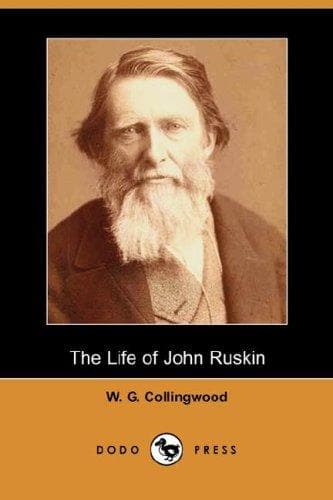
The Life of John RuskinCollingwood, W. G. (William Gershom)
Philosophy
The Life of John Ruskin
Collingwood, W. G. (William Gershom)
Authors, English -- 19th century -- Biography; Ruskin, John, 1819-1900
With that year expired the term for which he had been elected to the
Slade Professorship, and in January 1873 he was re-elected. In his first
three years he had given five courses of lectures designed to introduce
an encyclopædic review and reconstruction of all he had to say upon art.
Beginning with general principles, he had proceeded to their application
in history, by tracing certain phases of Greek sculpture, and by
contrasting the Greek and the Gothic spirit as shown in the treatment of
landscape, from which he went on to the study of early engraving. The
application of his principles to theory was made in the course on
Science and Art ("The Eagle's Nest"). Now, on his re-election, he
proceeded to take up these two sides of his subject, and to illustrate
this view of the right way to apply science to art, by a course on
Birds, in Nature, Art and Mythology, and next year by a study of Alpine
forms. The historical side was continued with lectures on Niccola Pisano
and early Tuscan sculpture, and in 1874 with an important, though
unpublished, course on Florentine Art.
It is to this cycle of lectures that we must look for that matured
Ruskinian theory of art which his early works do not reach; and which
his writings between 1860 and 1870 do not touch. Though the Oxford
lectures are only a fragment of what he ought to have done, they should
be sufficient to a careful reader; though their expression is sometimes
obscured by diffuse treatment, they contain the root of the matter,
thought out for fifteen years since the close of the more brilliant, but
less profound, period of "Modern Painters."
The course on Birds[29] was given in the drawing school at the
University Galleries. The room was not large enough for the numbers that
crowded to hear Professor Ruskin, and each of these lectures, like the
previous and the following courses, had to be repeated to a second
audience. Great pains had been given to their preparation--much greater
than the easy utterance and free treatment of his theme led his hearers
to believe. For these lectures and their sequel, published as "Love's
Meinie," he collected an enormous number of skins--to compare the
plumage and wings of different species; for his work was with the
_outside_ aspect and structure of birds, not with their anatomy. He had
models made, as large as swords, of the different quill-feathers, to
experiment on their action and resistance to the air. He got a valuable
series of drawings by H.S. Marks, R.A., and made many careful and
beautiful studies himself of feathers and of birds at the Zoological
Gardens, and the British Museum; and after all, he had to conclude his
work saying, "It has been throughout my trust that if death should write
on these, 'What this man began to build, he was not able to finish,' God
may also write on them, not in anger, but in aid, 'A stronger than he
cometh.'"
[Footnote 29: March 15, May 2 and 9; repeated March 19, May 5, and 12,
1873.]
Public-domain text, read in full here on John Shaqi.
Reviews
Reviews
No reviews yet
Be the first to share your thoughts on this work.
Elsewhere in the archive
Join the Discussion
Join the discussion
Sign in to leave a comment or review.
Sign InorCreate an account