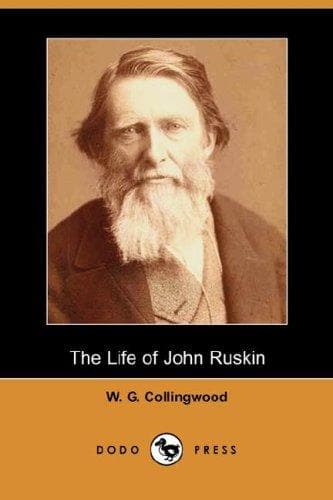
The Life of John RuskinCollingwood, W. G. (William Gershom)
Philosophy
The Life of John Ruskin
Collingwood, W. G. (William Gershom)
Authors, English -- 19th century -- Biography; Ruskin, John, 1819-1900
"The Professor," said Mr. Severn, "dislikes railways very much:" and on
his arrival at Brantwood after that posting journey he wrote a preface
to "A Protest against the Extension of Railways in the Lake District,"
by Mr. Robert Somervell. Ruskin's dislike of railways has been the text
of a great deal of misrepresentation, and his use of them, at all, has
been often quoted as an inconsistency. As a matter of fact, he never
objected to main lines of railway communication; but he strongly
objected, in common with a vast number of people, to the introduction of
railways into districts whose chief interest is in their scenery;
especially where, as in the English Lake district, the scenery is in
miniature, easily spoiled by embankments and viaducts, and by the rows
of ugly buildings which usually grow up round a station; and where the
beauty of the landscape can only be felt in quiet walks or drives
through it. Many years later, after he had said all he had to say on the
subject again and again, and was on the brink of one of his illnesses,
he wrote in violent language to a correspondent who tried to "draw" him
on the subject of another proposed railway to Ambleside. But his real
opinions were simple enough, and consistent with a practicable scheme of
life.
In August 1876 he left England for Italy. He travelled alone,
accompanied only by his new servant Baxter, who had lately taken the
place vacated by Crawley, Mr. Ruskin's former valet of twenty years'
service. He crossed the Simplon to Venice, where he was welcomed by an
old friend, Rawdon Brown, and a new friend, Prof. C.H. Moore, of
Harvard. He met two Oxford pupils, Mr. J. Reddie Anderson, whom he set
to work on Carpaccio; and Mr. Whitehead--"So much nicer they all are," he
wrote in a private letter, "than I was at their age;"--also his pupil
Mr. Bunney, at work on copies of pictures and records of architecture,
the legacy of St. Mark to St. George. Two young artists were brought
into his circle, during that winter--both Venetians, and both singularly
interesting men: Giacomo Boni, now a celebrated antiquary, then capo
d'opera of the Ducal Palace, and doing his best to preserve, instead of
"restoring," the ancient sculptures; and Angelo Alessandri, a painter of
more than usual seriousness of aim and sympathy with the fine qualities
of the old masters.
Public-domain text, read in full here on John Shaqi.
Reviews
Reviews
No reviews yet
Be the first to share your thoughts on this work.
Elsewhere in the archive
Join the Discussion
Join the discussion
Sign in to leave a comment or review.
Sign InorCreate an account