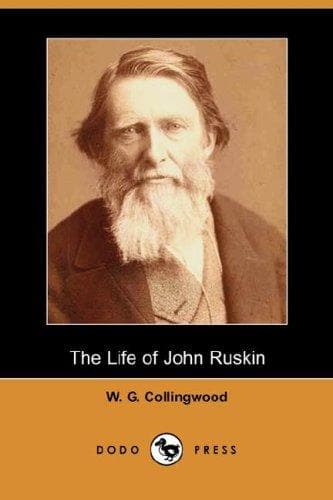
The Life of John RuskinCollingwood, W. G. (William Gershom)
Philosophy
The Life of John Ruskin
Collingwood, W. G. (William Gershom)
Authors, English -- 19th century -- Biography; Ruskin, John, 1819-1900
At Florence he met Mr. Henry Roderick Newman, an American artist who had
been at Coniston and was working for the Guild. He introduced Ruskin to
Mrs. and Miss Alexander. In these ladies' home he found his own aims, in
religion, philanthropy, and art, realised in an unexpected way. Miss
Alexander's drawing at first struck him by its sincerity. Not only did
she draw beautifully, but she also wrote a beautiful hand; and it had
been one of his old sayings that missal-writing, rather than
missal-painting, was the admirable thing in mediæval art. The legends
illustrated by her drawings were collected by herself, through an
intimate acquaintance with Italians of all classes, from the nobles to
the peasantry, whom she understood and loved, and by whom she was loved
and understood. By such intercourse she had learned to look beneath the
surface. In religious matters her American common-sense saw through her
neighbours--saw the good in them as well as the weakness--and she was as
friendly, not only in social intercourse, but in spiritual things, with
the worthy village priest as with T.P. Rossetti,[47] the leader of the
Protestant "Brethren," whom she called her pastor. And Ruskin, who had
been driven away from Protestantism by the poor Waldensian at Turin, and
had wandered through many realms of doubt and voyaged through strange
seas of thought, alone, found harbour at last with the disciple of a
modern evangelist, the frequenter of the little meeting-house of outcast
Italian Protestants.
[Footnote 47: A cousin of the artist, and in his way no less remarkable
a man. A short account of his life is given in "D.G. Rossetti, his
family letters," Vol. I., p. 34. The circumstances of his death are
touchingly related by Miss Alexander in "Christ's Folk; in the
Apennine."]
One evening before dinner he brought back to the hotel at Florence a
drawing of a lovely girl lying dead in the sunset; and a little
note-book. "I want you to look over this," he said, in the way, but not
quite in the tone, with which the usual MS. "submitted for criticism"
was tossed to a secretary to taste. It was "The True Story of Ida;
written by her Friend."
An appointment to meet Mr. E.R. Robson, who was making plans for an
intended Sheffield museum, took him back to Lucca, to discuss Romanesque
mouldings and marble facings. Mr. Charles Fairfax Murray also came to
Lucca with drawings commissioned for St. George's Guild. But Ruskin soon
returned to his new friends, and did not leave Florence finally until
he had purchased the wonderful collection of 110 drawings, with
beautifully written text, in which Miss Alexander had enshrined "The
Roadside Songs of Tuscany."
Public-domain text, read in full here on John Shaqi.
Reviews
Reviews
No reviews yet
Be the first to share your thoughts on this work.
Elsewhere in the archive
Join the Discussion
Join the discussion
Sign in to leave a comment or review.
Sign InorCreate an account