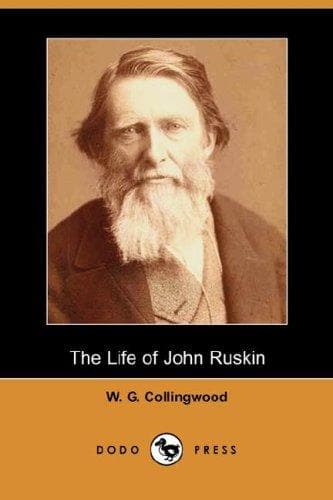
The Life of John RuskinCollingwood, W. G. (William Gershom)
Philosophy
The Life of John Ruskin
Collingwood, W. G. (William Gershom)
Authors, English -- 19th century -- Biography; Ruskin, John, 1819-1900
Though the sale of Ruskin's books in America had never, until so
recently, brought him any profit, his own business in England, started
in 1871 with the monthly pamphlet of "Fors," and in 1872 with the volume
of "Sesame and Lilies," prospered singularly. Mr. George Allen, who,
while building up an independent connection, still remained the sole
publisher of Mr. Ruskin's works, said that the venture was successful
from its earliest years. It was found that the booksellers were not
indispensable, and that business could be done through the post as well
as over the counter. In spite of occasional difficulties, such as the
bringing out of works in parts, appearing irregularly or stopping
outright at the author's illnesses, there was a steady increase of
profit, rising in the author's later years (according to Mr. Allen) to
an average of £4,000.
Fortunate it was that this bold attempt succeeded. The £200,000 he
inherited from his parents had gone,--chiefly in gifts and in attempts
to do good. The interest he used to spend on himself; the capital he
gave away until it totally disappeared, except what is represented by
the house he lived in and its contents. The sale of his books was his
only income, and a great part of that went to pensioners to whom in the
days of his wealth he pledged himself, to relatives and friends,
discharged servants, institutions in which he took an interest at one
time or other. But he had sufficient for his wants, and no need to fear
poverty in his old age.
In this quiet retreat at Brantwood the echoes of the outer world did
not sound very loudly. Ruskin had been too highly praised and too
roundly abused, during fifty years of public life, to care what magazine
critics and journalists said of him. Other men of his standing could
solace themselves, if it be solace, in the consciousness that a grateful
country has recognised their talents or their services. But civic and
academic honours were not likely to be showered on a man who had spent
his life in strenuous opposition to academicism in art and letters, and
in vigorous attacks upon both political parties, and upon the
established order of things.
And yet Oxford and Cambridge awarded him the highest honours in their
gift. In 1873 the Royal Society of Painters in Watercolours voted him
honorary member, a recognition which gave him great pleasure at the time.
At different dates he was elected to various societies--Geological,
Zoological, Architectural, Horticultural, Historical, Anthropological,
Metaphysical; and to the Athenæum and Alpine Clubs. He was elected Hon.
Member of the Academy of Florence in 1862, of the Academy of Venice,
1877, of the Royal Academies of Antwerp and Brussels in 1892; and was
also an Hon. Member of the American Academy. But he did not seek
distinctions, and he even declined them, as in the case of the medal of
the Royal Institute of British Architects.
Public-domain text, read in full here on John Shaqi.
Reviews
Reviews
No reviews yet
Be the first to share your thoughts on this work.
Elsewhere in the archive
Join the Discussion
Join the discussion
Sign in to leave a comment or review.
Sign InorCreate an account