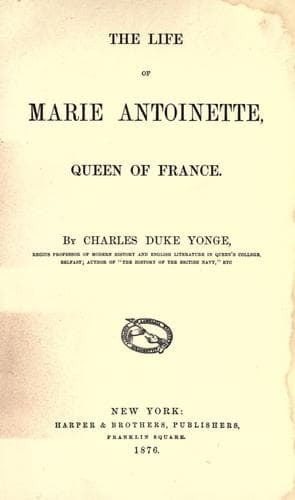
The Life of Marie Antoinette, Queen of FranceYonge, Charles Duke
History
The Life of Marie Antoinette, Queen of France
Yonge, Charles Duke
Marie Antoinette, Queen, consort of Louis XVI, King of France, 1755-1793
But this addiction to play, though it was that consequence of the
influence of the society to which Marie Antoinette was at this time so
devoted, which would have seemed the most objectionable in the eyes of
rigid moralists, was not that which excited the greatest dissatisfaction
in the neighborhood of the court. Excessive gambling had so long been a
notorious vice of the French princes, that her letting herself down to
join the gaming-table was not regarded as indicating any peculiar laxity
of principle; while the stakes which she permitted herself, and the losses
she incurred, though they seemed heavy to her anxious German friends, were
as nothing when compared with those of the king's brothers. Even when it
became known that she was involved in debt, that again was regarded as an
ordinary occurrence, apparently even by the king himself, who paid the
amount (about £20,000) without a word of remonstrance, merely remarking
that he did not wonder at her funds being exhausted since she had such a
passion for diamonds. For a great portion of the debts had been incurred
for some diamond ear-rings which the queen herself did not wish for, and
had only bought to gratify Madame de Polignac, who had promised her custom
to the jeweler who had them for sale. Marie Antoinette had evidently
become less careful in regulating her expenses, till she was awakened by
the discovery of a crime which she herself imputed to her own carelessness
in such matters. The wife of the king's treasurer had borrowed money in
her name, and had forged her handwriting to letters of acknowledgment of
the loans. The fraud was only discovered through Mercy's vigilance, and
the criminal was at seized and punished, but it proved a wholesome lesson
to the queen, who never forgot it, though, as we shall see hereafter, if
others remembered it, the recollection only served to induce them to try
and enrich themselves by similar knaveries.
And this devotion of the queen to the society of the Polignacs and
Guimenées, "her society," as she sometimes called it,[1] had also a
mischievous effect in diminishing her popularity with the great body of
the nobles. The custom of former sovereigns had been to hold receptions
several evenings in each week, to which the men and women of the highest
rank were proud to repair to pay their court. But now the royal apartments
were generally empty, the king being alone in his private cabinet, while
the queen was passing her time at some small private party of young
people, by her presence often seeming to countenance intrigues of which
she did not in her heart approve, and giddy conversation which was hardly
consistent with her royal position; though Mercy, in reporting these
habits to the empress, adds that the queen's own demeanor, even in the
moments of apparently unrestrained familiarity, was marked by such uniform
self-possession and dignity, that no one ever ventured to take liberties
with her, or to approach her without the most entire respect.[2]
Public-domain text, read in full here on John Shaqi.
Reviews
Reviews
No reviews yet
Be the first to share your thoughts on this work.
Elsewhere in the archive
Join the Discussion
Join the discussion
Sign in to leave a comment or review.
Sign InorCreate an account