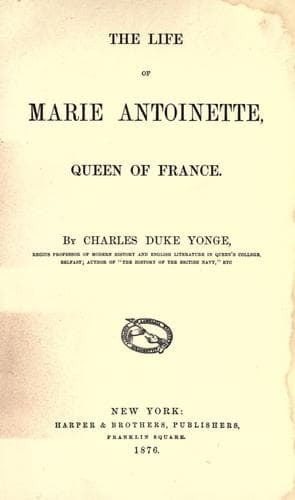
The Life of Marie Antoinette, Queen of FranceYonge, Charles Duke
History
The Life of Marie Antoinette, Queen of France
Yonge, Charles Duke
Marie Antoinette, Queen, consort of Louis XVI, King of France, 1755-1793
If Versailles was less lively than usual, Paris, on the other hand, had
never been so gay as during the carnival of 1777. The queen went to
several of the masked balls at the opera with one or other of her
brothers-in-law and their wives; the king expressing his perfect
willingness that she should so amuse herself, but never being able to
overcome his own indolence and shyness so far as to accompany her. It
could not have been a very lively amusement. She did not dance, but sat in
an arm-chair surveying the dancers, or walked down the saloon attended by
an officer of the bodyguard and one lady in waiting, both masked like
herself. Occasionally she would grant to some noble of high rank the honor
of walking at her side; but it was remarked that those whom she thus
distinguished were often foreigners; some English noblemen, such as the
Duke of Dorset and Lord Strathavon being especially favored, for a reason
which, as given by Mercy, shows that that insular stiffness which, with
national self-complacency, Britons sometimes confess as a not unbecoming
characteristic, was not at that time attributed to them by others; since
the ambassador explains the queen's preference by the self-evident fact
that the English gentlemen were the best dancers, and made the best figure
in the ball-room.
But all the other festivities of this winter were thrown into the shade by
an entertainment of extraordinary magnificence, which was given in the
queen's honor by the Count de Provence at his villa at Brunoy.[3] The
count was an admirer of Spenser, and appeared to desire to embody the
spirit of that poet of the ancient chivalry in the scene which he
presented to the view of his illustrious guest when she entered his
grounds. Every one seemed asleep. Groups of cavaliers, armed _cap-a-pie_,
and surrounded by a splendid retinue of squires and pages, were seen
slumbering on the ground; their lances lying by their sides, their shields
hanging on the trees which overshadowed them; their very horses reposing
idly on the grass on which they cared not to browse. All seemed under the
influence of a spell as powerful as that under which Merlin had bound the
pitiless daughter of Arthur; but the moment that Marie Antoinette passed
within the gates the enchantment was dissolved; the pages sprung to their
feet, and brought the easily roused steeds to their awakened masters.
Twenty-five challengers, with scarfs of green, the queen's favorite color,
on snow-white chargers, overthrew an equal number of antagonists; but no
deadly wounds were given. The victory of her champions having been
decided, both parties of combatants mingled as spectators at a play, and
afterward as dancers at a grand ball which was wound up by a display of
fire-works and a superb illumination, of which the principal ornament was
a gorgeous bouquet of flowers, in many-colored fire, lighting up the
inscription "Vive Louis! Vive Marie Antoinette!"
Public-domain text, read in full here on John Shaqi.
Reviews
Reviews
No reviews yet
Be the first to share your thoughts on this work.
Elsewhere in the archive
Join the Discussion
Join the discussion
Sign in to leave a comment or review.
Sign InorCreate an account