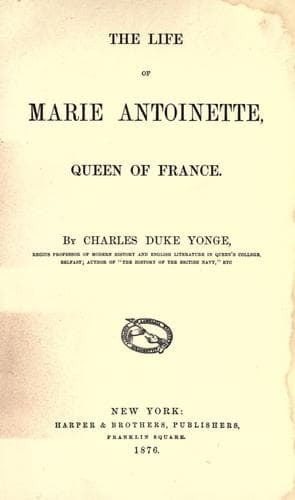
The Life of Marie Antoinette, Queen of FranceYonge, Charles Duke
History
The Life of Marie Antoinette, Queen of France
Yonge, Charles Duke
Marie Antoinette, Queen, consort of Louis XVI, King of France, 1755-1793
High-strung expectations often insure their own disappointment, but it was
not so in this instance; though the august visitor's first act displayed
an eccentricity of disposition which must have led more people than one to
entertain secret misgivings as to the consequences which might flow from a
visit which had such a commencement. Like his brother Maximilian, he too
traveled incognito, under the title of the Count Falkenstein; and he
persisted in maintaining his disguise so absolutely that he refused to
occupy the apartments which the queen had prepared for him in the palace,
and insisted on taking up his quarters with Mercy in Paris, and at a
hotel, for the few days which he passed at Versailles.
However, though by his conduct in this matter he to some extent
disappointed the hope which his sister had conceived of an uninterrupted
intercourse with him during his stay in France, in every other respect the
visit passed off to the satisfaction of all the parties principally
concerned. Fortunately, at their first interview Marie Antoinette herself
made a most favorable impression on him. She had been but a child when he
had last seen her. She was now a woman, and he was wholly unprepared for
the matured and queenly beauty at which she had arrived. He was not a man
to flatter any one, but almost his first words to her were that, had she
not been his sister, he could not have refrained from seeking her hand
that he might secure to himself so lovely a partner; and each succeeding
meeting strengthened his admiration of her personal graces. She, always
eager to please, was gratified at the feeling she had inspired; and thus
an affectionate tone was from the first established between them, and all
reserve was banished from their conversation. It was not diminished by the
admonitions which, as he conceived, his age and greater experience
entitled him to address to her, though sometimes they took the form of
banter and ridicule, sometimes that of serious reproof;[5] but she bore
all his lectures with unvarying good humor, promising him that the time
should come when she would make the amendment which he desired; never
attempting to conceal from him, and scarcely to excuse, the faults of
which she was not unconscious, nor the vexations which in some particulars
continually disquieted her.
Public-domain text, read in full here on John Shaqi.
Reviews
Reviews
No reviews yet
Be the first to share your thoughts on this work.
Elsewhere in the archive
Join the Discussion
Join the discussion
Sign in to leave a comment or review.
Sign InorCreate an account