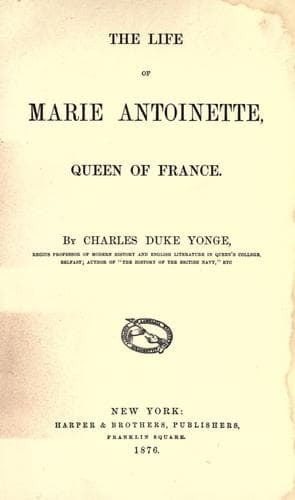
The Life of Marie Antoinette, Queen of FranceYonge, Charles Duke
History
The Life of Marie Antoinette, Queen of France
Yonge, Charles Duke
Marie Antoinette, Queen, consort of Louis XVI, King of France, 1755-1793
It is a letter very characteristic of the writer, as showing that neither
time nor distance could chill her affection for her family; and that the
attainment of royal authority had in no degree extinguished her habitual
feeling of duty: that it had even strengthened it by making its
performance of importance not only to herself, but to others. Nor is the
jealousy for the reputation of the French people, and the desire so warmly
professed that they should have won her brother's favorable opinion, less
becoming in a queen of France; while, to descend to minor points, the
neatness and felicity of the language may be admitted to prove, if her
education had been incomplete when she left Austria, with how much pains,
since her progress had depended on herself, she had labored to make up for
its deficiencies. That she should have asked her brother, as she here
mentions, to leave her his advice in writing, is a practical proof that
her expression of an earnest desire to do her duty was not a mere form of
words; while the resolution which she avows never to forget his
admonitions shows a genuine humility and candor, a sincere desire to be
told of and to amend her faults, which one is hardly prepared to meet with
in a queen of one-and-twenty. For Joseph did not spare her, nor forbear to
set before her in the plainest light those parts of her conduct which he
disapproved. He told her plainly that if in France people paid her respect
and observance, it was only as the wife of their king that they honored
her; and that the tone of superiority in which she sometimes allowed
herself to speak of him was as ill-judged as it was unbecoming. He hinted
his dissatisfaction at her conduct toward him as her husband in a series
of questions which, unless she could answer as he wished, must, even in
her own judgment, convict her of some failure in her duties to him. Did
she show him that she was wholly occupied with him, that her study was to
make him shine in the opinion of his subjects without any thought of
herself? Did she stifle every wish to shine at his expense, to be affable
when he was not so, to seem to attend to matters which he neglected? Did
she preserve a discreet silence as to his faults and weaknesses, and make
others keep silence about them also? Did she make excuses for him, and
keep secret the fact of her acting as his adviser? Did, she study his
character, his wishes? Did she take care never to seem cold or weary when
with him, never indifferent to his conversation or his caresses?
Public-domain text, read in full here on John Shaqi.
Reviews
Reviews
No reviews yet
Be the first to share your thoughts on this work.
Elsewhere in the archive
Join the Discussion
Join the discussion
Sign in to leave a comment or review.
Sign InorCreate an account