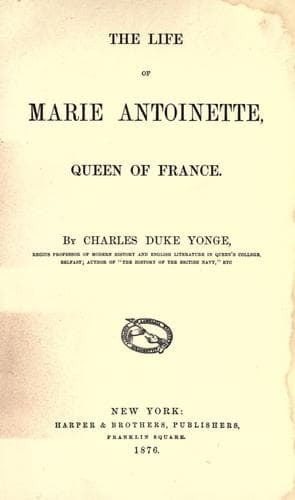
The Life of Marie Antoinette, Queen of FranceYonge, Charles Duke
History
The Life of Marie Antoinette, Queen of France
Yonge, Charles Duke
Marie Antoinette, Queen, consort of Louis XVI, King of France, 1755-1793
Throughout the autumn her occupations and amusements were of a simpler
kind. She read more, and agreeably surprised De Vermond by the soundness
of her reflections on many incidents and characters in history. Accounts
of chivalrous deeds had an especial charm for her. Hume was still her
favorite author. And it happened that, while the gallantry of the loyal
champions of Charles I. was fresh in her memory, a casual conversation
threw in her way an opportunity of doing honor to the self-devoted heroism
of a French soldier whom the proudest of the British cavaliers might have
welcomed as a brother, but whose valiant and self-sacrificing fidelity had
been left unnoticed by the worthless sovereign in whose service he had
perished, and by his ministers, who thought only of securing the favor of
the reigning mistress--favor to be won by actions of a very different
complexion.
In the Seven Years' War, when the French army, under the Marshal De
Broglie, and the Prussians, under Prince Ferdinand of Brunswick, were
watching one another in the neighborhood of Wesel, the Chevalier d'Assas,
a captain in the regiment of Auvergne, was in command of an outpost on a
dark night of October. He had strolled a little in advance of his sentries
into the wood which fronted his position, when suddenly he found himself
surrounded and seized by a body of armed enemies. They were the advanced
guard of the prince's army, who was marching to surprise De Broglie by a
night attack, and they threatened him with instant death if he made the
slightest noise. If he were but silent, he was safe as a prisoner of war;
but his safety would have been the ruin of the whole French army, which
had no suspicion of its danger. He did not for even a moment hesitate.
With all the strength of his voice he shouted to his men, who were within
hearing, that the enemy were upon them, and fell, bayoneted to death,
almost before the words had passed his lips. He had saved his comrades and
his commander, and had influenced the issue of the whole campaign. The
enemy, whose well-planned enterprise his self-devotion had baffled, paid a
cordial tribute of praise to his heroism, Ferdinand himself publicly
expressing his regret at the fate of one whose valor had shed honor on
every brother-soldier; but not the slightest notice had been taken of him
by those in authority in France till his exploit was accidentally
mentioned in the queen's apartments. It filled her with admiration. She
asked what had been done to commemorate so noble a deed. She was told
"nothing;" the man and his gallantry had been alike forgotten. "Had he
left descendants or kinsmen?" "He had a brother and two nephews; the
brother a retired veteran of the same regiment, the nephews officers in
different corps of the army." The dead hero was forgotten no longer. Marie
Antoinette never rested till she had procured an adequate pension for the
brother, which was settled in perpetuity on the family; and promotion for
Public-domain text, read in full here on John Shaqi.
Reviews
Reviews
No reviews yet
Be the first to share your thoughts on this work.
Elsewhere in the archive
Join the Discussion
Join the discussion
Sign in to leave a comment or review.
Sign InorCreate an account