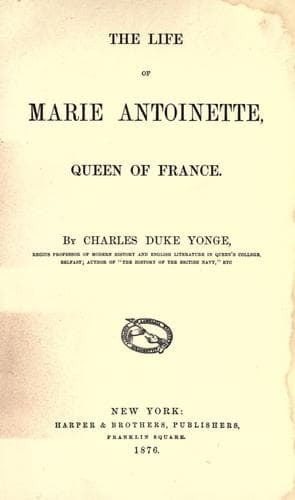
The Life of Marie Antoinette, Queen of FranceYonge, Charles Duke
History
The Life of Marie Antoinette, Queen of France
Yonge, Charles Duke
Marie Antoinette, Queen, consort of Louis XVI, King of France, 1755-1793
It was well for Marie Antoinette's happiness that her husband was one in
whom, as we have seen that she told her mother, she could feel entire
confidence, for during her seclusion in the measles the intriguers of the
court had ventured to try and work upon him. Mercy had reason to suspect
that some were even wicked enough to desire to influence him against his
wife by the same means by which the Duke de Richelieu had formerly
alienated his grandfather from Marie Leczinska; and the queen herself
received proof positive that Maurepas, in spite of her civilities to him
and his countess, had become jealous of her political influence, and had
endeavored to prevent his consulting her on public affairs. But all
manoeuvres intended to disturb the conjugal felicity of the royal pair
were harmless against the honest fidelity of the king, the graceful
affection of the queen, and the firm confidence of each in the other. The
people generally felt that the influence which it was now notorious that
the queen did exert on public affairs was a salutary one; and great
satisfaction was expressed when it became known in the autumn that the
usual visit to Fontainebleau was given up, partly as being costly, and
therefore undesirable while the nation had need to concentrate all its
resources on the effective prosecution of the war, and partly that the
king might be always within reach of his ministers in the event of any
intelligence of importance arriving which required prompt decision.
Her letters to her mother at this time show how entirely her whole
attention was engrossed by the war; and, at the same time, with what wise
earnestness she desired the re-establishment of peace. Even some gleams of
success which had attended the French arms in the West Indies, where the
Marquis de Bouillé, the most skillful soldier of whom France at that time
could boast, took one or two of the British islands, and the Count
d'Estaing, whose fleet of thirty-six sail was for a short time far
superior to the English force in that quarter, captured one or two more,
did not diminish her eagerness for a cessation of the war. Though it is
curious to see that she had become so deeply imbued with the principles of
statesmanship with which M. Necker, the present financial minister, was
seeking to inspire the nation, that her objections to the continuance of
the war turned chiefly on the degree in which it affected the revenue and
expenditure of the kingdom. She evidently sympathizes in the
disappointment which, as she reports to the empress, is generally felt by
the public at the mismanagement of the admiral, M. d'Orvilliers, who, with
forces so superior to those of the English, has neither been able to fall
in with them so as to give them battle, nor to hinder any of their
merchantmen from reaching their harbors in safety. As it is, he will have
spent a great deal of money in doing nothing.[12] And a month later she
repeats the complaints.[13] The king and she have renounced the journey
Public-domain text, read in full here on John Shaqi.
Reviews
Reviews
No reviews yet
Be the first to share your thoughts on this work.
Elsewhere in the archive
Join the Discussion
Join the discussion
Sign in to leave a comment or review.
Sign InorCreate an account