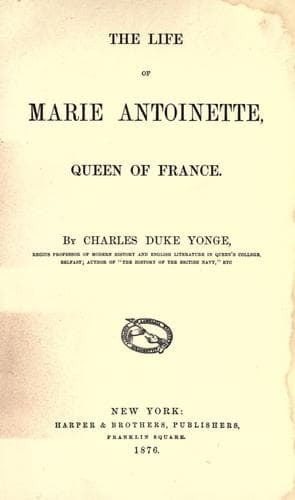
The Life of Marie Antoinette, Queen of FranceYonge, Charles Duke
History
The Life of Marie Antoinette, Queen of France
Yonge, Charles Duke
Marie Antoinette, Queen, consort of Louis XVI, King of France, 1755-1793
The winter of 1779 and the spring of 1780 passed very happily. If
Versailles, from the reasons mentioned above, was not as crowded as in
former years, it was very lively. The season was unusually mild; the
hunting was scarcely ever interrupted, and Marie Antoinette, who now made
it a rule to accompany her husband on every possible occasion, sometimes
did not return from the hunt till the night was far advanced, and found
her health much benefited by the habit of spending the greater part of
even a winter's day in the open air. Her garden, too, which daily occupied
more and more of her attention, as it increased in beauty, had the same
tendency; and her anxiety to profit by the experience of others on one
occasion inflicted a whimsical disappointment of the free-thinkers of the
court. The profligate and sentimental infidel Rousseau had died a couple
of years before, and had been buried at Ermenonville, in the park of the
Count de Girardin. In the course of the summer the queen drove over to
Ermenonville, and the admirers of the versatile writer flattered
themselves that her object was to pay a visit of homage to the shrine of
their idol; but they wore greatly mortified to find that, though his tomb
was pointed out to her, she took no further notice of it than such as
consisted of a passing remark that it was very neat, and very prettily
placed; and that what had attracted her curiosity was the English garden
which the count had recently laid out at a great expense, and from which
she had been led to expect that she might derive some hints for the
further improvement of her own Little Trianon.
She had not yet entirely given up her desire for novelty in her
amusements; and she began now to establish private theatricals at
Versailles, choosing light comedies interspersed with song, and with but
few characters, the male parts being filled by the Count d'Artois and some
of the most distinguished officers of the household, while she herself
took one of the female parts; the spectators being confined to the royal
family and those nobles whose posts entitled them to immediate attendance
on the king and queen. She was so anxious to perform her own part well,
though she did not take any of the principal characters, but preferred to
act the waiting-woman rather than the mistress, that she placed herself
under the tuition of Michu, a professional actor of reputation from one of
the Parisian theatres; but, though the audience was far too courtly to
greet her appearance on the stage without vociferous applause, the
preponderance of evidence must lead us to believe that her majesty was not
a good actress.[1] And perhaps we may think that as the parts which she
selected required rather an arch pertness than the grace and majesty which
were more natural to her, so, also, they were not altogether in keeping
with the stately dignity which queens should never wholly lay aside.
Public-domain text, read in full here on John Shaqi.
Reviews
Reviews
No reviews yet
Be the first to share your thoughts on this work.
Elsewhere in the archive
Join the Discussion
Join the discussion
Sign in to leave a comment or review.
Sign InorCreate an account