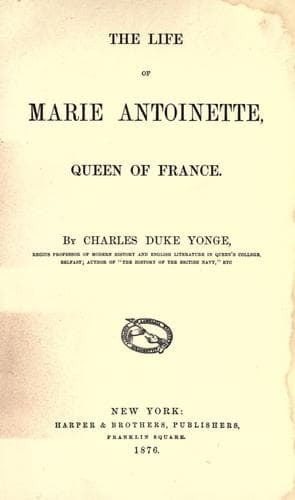
The Life of Marie Antoinette, Queen of FranceYonge, Charles Duke
History
The Life of Marie Antoinette, Queen of France
Yonge, Charles Duke
Marie Antoinette, Queen, consort of Louis XVI, King of France, 1755-1793
But this and all other vexations were presently thrown into the shade by a
great grief, the more difficult to bear because it was wholly unexpected
by her--the death of her mother. In reality, Maria Teresa had been unwell
for some time; but the suspicions of the serious character of her
complaint, which she secretly entertained, she had never revealed to Marie
Antoinette; and at last the end followed too quickly on the first
appearance of danger to allow time for any preparatory warnings to be
received at Versailles before the fatal intelligence arrived. On the 24th
of November she was taken ill in a manner which excited the alarm of her
physicians, but her family felt no apprehensions. Even on the 27th, the
emperor felt so sanguine that the cough which seemed her most distressing
symptom was but temporary, that it was with the greatest unwillingness
that he consented to her receiving the communion, as the physicians
recommended; but the next day even he was forced to acquiesce in the
hopeless view which they took of their patient; and on the 29th she died,
after having borne sufferings, which for the last three days had been of
the most painful character, with the same heroism with which, in her
earlier life, she had struggled against griefs of a different kind.
The dispatch announcing her death was brought to the king; and it is
characteristic of his timid disposition that he could not nerve himself to
communicate it to his wife, but suppressed all mention of it during the
evening; and in the morning summoned the Abbé de Vermond, and employed him
to break the news to her, reserving for himself the less painful task of
approaching her with words of affectionate consolation after the first
shock was over. For a time, however, she was almost overwhelmed with
sorrow. She attempted to write to her brother, but after a few lines she
closed the letter, declaring that her tears prevented her from seeing the
paper; and those about her found that for some time she could bear no
other topic of conversation than the courage, the wisdom, the greatness of
her mother, and, above all, her warm affection for herself and for all her
other children.[4]
With the death of the empress we lose the aid of Mercy's correspondence,
which has afforded such invaluable service in the light it has thrown on
the peculiarities of Marie Antoinette's position, and the gradual
development of her character during the earlier years of her residence in
France. We shall again obtain light from the same source of almost greater
importance, when the still more terrible dangers of the Revolution
rendered the queen more dependent than ever on his counsels. But for the
next few years we shall be compelled to content ourselves with scantier
materials than have been furnished by the empress's unceasing interest in
her daughter's welfare, and the embassador's faithful and candid reports.
Public-domain text, read in full here on John Shaqi.
Reviews
Reviews
No reviews yet
Be the first to share your thoughts on this work.
Elsewhere in the archive
Join the Discussion
Join the discussion
Sign in to leave a comment or review.
Sign InorCreate an account