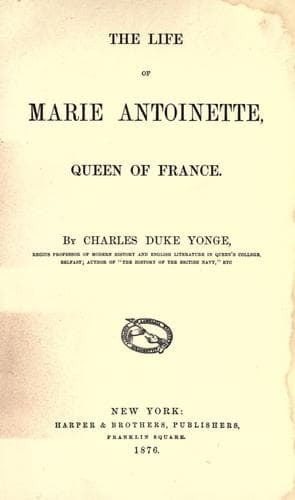
The Life of Marie Antoinette, Queen of FranceYonge, Charles Duke
History
The Life of Marie Antoinette, Queen of France
Yonge, Charles Duke
Marie Antoinette, Queen, consort of Louis XVI, King of France, 1755-1793
she had become the mother of a second daughter. But she desired to be
assured of the fact. "See," said she to Louis, "how reasonable I am. I ask
no questions.[2]" And Louis, who from joy was scarcely able to contain
himself, seeing her freedom from agitation, thought he might safely reveal
to her the whole extent of their happiness. He called out, so as to be
heard by the Princess de Guimenée, who still held the post of governess to
the royal children, and who had already exhibited the child to the
witnesses in the antechamber, and was now awaiting his summons at the open
door, "My lord the dauphin begs to be admitted." The Princess de Guimenée
brought "my lord the dauphin" to his mother's arms, and for a few minutes
the small company in the room gazed in respectful silence while the father
and mother mingled tears of joy with broken words of thanksgiving.
Yet even in this moment of exultation Marie Antoinette could not forget
her first-born, nor the feelings which had made her rejoice at the birth
of a daughter, who still had, as it were, no rival in her eyes, because no
rival claim to her own could be set up with respect to a princess. She
kissed the long-wished-for infant over and over again; pressed him fondly
to her heart; and then, after she had perused each feature with anxious
scrutiny, and pointed out some resemblances, such as mothers see, to his
father, "Take him," said she, to Madame de Guimenée; "he belongs to the
State; but my daughter is still mine.[3]"
Presently the chamber was cleared; and in a few minutes the glad tidings
were carried to every corner of the palace and town of Versailles, and, as
speedily as expresses could gallop, to the anxious city of Paris. By a
somewhat whimsical coincidence, the Count de Stedingk, who, from having
been one of the intended hunting-party, had been admitted into the
antechamber, rushing down-stairs in his haste to spread the intelligence,
met the Countess de Provence on the staircase. "It is a dauphin, madame,"
he cried; "what a happy event!" The countess made him no reply. Nor did
she or her husband pretend to disguise their mortification. The Count
d'Artois was a little less open in the display of his discontent, which
was, however, sufficiently notorious. But, with these exceptions, all
France, or at least all France sufficiently near the court to feel any
personal interest in its concerns, was unanimous in its exultation.
Public-domain text, read in full here on John Shaqi.
Reviews
Reviews
No reviews yet
Be the first to share your thoughts on this work.
Elsewhere in the archive
Join the Discussion
Join the discussion
Sign in to leave a comment or review.
Sign InorCreate an account