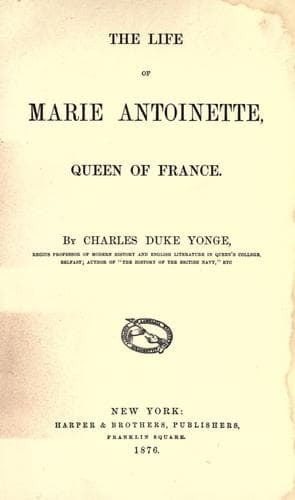
The Life of Marie Antoinette, Queen of FranceYonge, Charles Duke
History
The Life of Marie Antoinette, Queen of France
Yonge, Charles Duke
Marie Antoinette, Queen, consort of Louis XVI, King of France, 1755-1793
The festivities were crowned in the most appropriate manner by a public
thanksgiving, offered by the queen herself to Heaven for the gift of a
son, and for her own recovery. But that celebration was necessarily
postponed till her strength was entirely re-established; and it was not
till the 21st of January that the physicians would allow her to encounter
the excitement of so interesting but fatiguing a day. The court had quit
Versailles for La Muette the day before, to be nearer the city; and on the
appointed morning, which the watchers for omens delightedly remarked as
one of midsummer brilliancy,[8] the most superb procession that even Paris
had ever witnessed issued from the gates of the old hunting-lodge, whose
earlier occupants had been animated by a very different spirit.[9]
That the honors of the day might be wholly the queen's, Louis himself did
not accompany her, but followed her three hours later, to meet her at the
Hôtel de Ville. Nineteen coaches, glittering with burnished gold, and
every panel of which was embellished with crowns, wreaths, or allegorical
pictures, marching on at a stately walk toward the city gate, conveyed the
queen, radiant with beauty and happiness, the sisters and aunts of the
king, the long train of her and their ladies, and all the great officers
of her household. Squadrons of the body-guard furnished the escort, riding
in front of the queen's carriage and behind it, but not on either side,
she herself having forbidden any arrangement which might intercept the
full sight of herself from a single citizen. Companies of other regiments
awaited the procession at different points, and closed up behind it as it
passed, swelling the vast train which thus grew at every step. An
additional escort, almost an army in itself, in double rank, lined the
whole road from the barrier of the Champs Élysées of the great cathedral;
and, as the royal coach passed through the city gate, a herald proclaimed
that "The king wishing to consecrate by fresh acts of kindness the happy
moment when God showered his mercies on him by the birth of a dauphin, and
at the same time to give to the inhabitants of his good city of Paris some
special mark of his beneficence, granted an exemption from the poll-tax to
all the burgesses, traders, and artisans who were not in such
circumstances as made the payment easy."
Public-domain text, read in full here on John Shaqi.
Reviews
Reviews
No reviews yet
Be the first to share your thoughts on this work.
Elsewhere in the archive
Join the Discussion
Join the discussion
Sign in to leave a comment or review.
Sign InorCreate an account