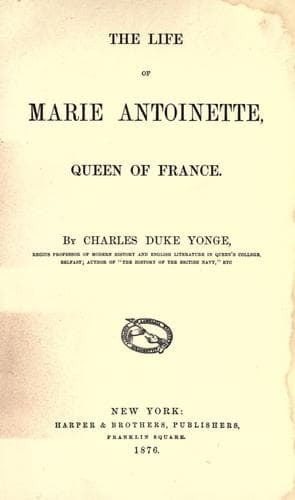
The Life of Marie Antoinette, Queen of FranceYonge, Charles Duke
History
The Life of Marie Antoinette, Queen of France
Yonge, Charles Duke
Marie Antoinette, Queen, consort of Louis XVI, King of France, 1755-1793
Madame de Guimenée resigns the Office of Governess of the Royal Children.
--Madame de Polignac succeeds her.--Marie Antoinette's Views of
Education.--Character of Madame Royale.--The Grand Duke Paul and his Grand
Duchess visit the French Court.--Their Characters.--Entertainments given
in their Honor.--Insolence of the Cardinal de Rohan.--His Character and
previous Life.--Grand Festivities at Chantilly.--Events of the War.--
Rodney defeats de Grasse.--The Siege of Gilbralter fails.--M. de Suffrein
fights five Drawn Battles with Sir E. Hughes in the Indian Seas.--The
Queen receives him with great Honor on his Return.
The post of governess to the royal children was one which was conferred
for life, and did not even cease on the accession of a new sovereign, and
the birth of a new royal family. Madame de Guimenée, therefore, having
been appointed to that office on the birth of the first child of the late
dauphin, the father of Louis XVI., still retained it, and on the birth of
Madame Royale transferred her services to that princess. The arrangement
had been far from acceptable to Marie Antoinette, who had no great liking
for the lady, though, with her habitual kindness of disposition, she had
accepted her attentions, and had often condescended to appear as a guest
at her evening parties, taking only the precaution of ascertaining
beforehand whom she was likely to meet there.[1] But, in the spring of
1782, the Prince de Guimenée became involved in pecuniary difficulties
that compelled him to retire from the court, and his princess to resign
her appointment, which Marie Antoinette at once bestowed on Madame de
Polignac. Her attachment to that lady affords a striking exemplification
of one feature in her character, a steady adherence to friendships once
formed, which can never be otherwise than amiable, even when, as it may be
thought was the case in this and one or two other instances, she carried
it to excess; for she could hardly fail to be aware that Madame de
Polignac was most unpopular with all classes, and that her unpopularity
was not undeserved. She was covetous for herself, and she had a number of
relations, equally rapacious, who regarded her court favor solely as a
means of enriching the whole family. She had procured a valuable reversion
for her husband; and subsequently the rare favor of an hereditary dukedom;
and it was characteristic of her disposition that she might have attained
the rank of duchess for herself at an earlier date, but that she preferred
to it the chance of other favors of a more practically useful nature; nor
was it till she had received such sums of money that nothing more could
well be asked, that she turned her ambition to titles, and to the
much-coveted dignity of a stool to sit upon in the presence of royalty.[2]
Public-domain text, read in full here on John Shaqi.
Reviews
Reviews
No reviews yet
Be the first to share your thoughts on this work.
Elsewhere in the archive
Join the Discussion
Join the discussion
Sign in to leave a comment or review.
Sign InorCreate an account