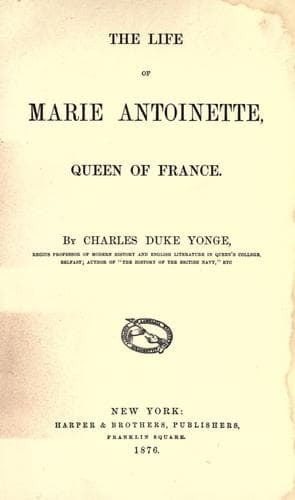
The Life of Marie Antoinette, Queen of FranceYonge, Charles Duke
History
The Life of Marie Antoinette, Queen of France
Yonge, Charles Duke
Marie Antoinette, Queen, consort of Louis XVI, King of France, 1755-1793
Nor were these lessons, which even worldly policy might have dictated, the
only ones which she sought to inculcate on the little princess before the
more exciting pursuits of society should have rendered her less
susceptible to good impressions. Unfriendly as her husband's aunts had
always been to herself, and little as there was that was really amiable in
their characters, there was yet one, the Princess Louise, the Nun of St.
Denis, whose renunciation of the world seemed to point her out to her
family as a model of holiness and devotion; and as, above all things,
Marie Antoinette desired to inspire her little daughter with a deep sense
of religious obligation, she soon began to take her with her in all her
visits to the convent, and to encourage her to converse with the other
Sisters of the house. Nor did she abandon the practice even when it was
suggested to her that such an intercourse with those who were notoriously
always on the watch to attract recruits of rank or consideration, might
have the result of inclining the child to follow her great-aunt's example;
and perhaps, by renouncing the world, to counteract plans which her
parents might have preferred for her establishment in life. Marie
Antoinette declared that should the princess express such a desire, far
from being annoyed, "she should feel flattered by it;[4]" she would, it
may be presumed, have regarded it as a convincing testimony of the
soundness of her own system of education, and of the purity of the
instruction which she had given.
But such was not to be the destiny of her whose life at this moment seemed
to beam with prospects of happiness which it would have been cruel to
allow her to exchange for the gloom of a convent, though, even before she
arrived at womanhood, the most austere seclusion of such an abode would
have seemed a welcome asylum from dangers yet undreamed of. Her destiny
was indeed to be one of trials and afflictions even to the end; trials
very different in their kind from those which the gates of the Carmelite
sisterhood would have opened to her. But her mother's early lessons of
humility and piety, and still more her mother's virtuous and heroic
example, never ceased to bear their fruit in their influence on her
character, amidst all the vicissitudes of fortune. The unhappy
daughter,[5] as she was styled by the faithful and eloquent champion of
her race, lived to win the respect even of its enemies,[6] supplying, at
more than one critical moment, a courage and decision of which her male
relatives were destitute; and, in the second and final ruin of her house,
her fortitude and resignation still commanded the loyal adherence of a
large party among her countrymen, and the esteem of foreign statesmen, who
gladly recognized in her no small portion of the nobility of her female
ancestors.
Public-domain text, read in full here on John Shaqi.
Reviews
Reviews
No reviews yet
Be the first to share your thoughts on this work.
Elsewhere in the archive
Join the Discussion
Join the discussion
Sign in to leave a comment or review.
Sign InorCreate an account