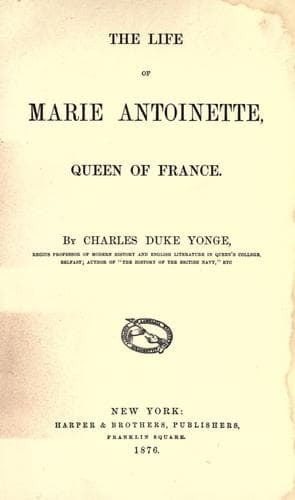
The Life of Marie Antoinette, Queen of FranceYonge, Charles Duke
History
The Life of Marie Antoinette, Queen of France
Yonge, Charles Duke
Marie Antoinette, Queen, consort of Louis XVI, King of France, 1755-1793
Peace is re-established.--Embarrassments of the Ministry.--Distress of the
Kingdom.--M. de Calonne becomes Finance Minister.--The Winter of 1783-'84
is very Severe.--The Queen devotes Large Sums to Charity.--Her Political
Influence increases--Correspondence between the Emperor and her on
European Politics.--The State of France.--The Baron de Breteuil.--Her
Description of the Character of the King.
The conclusion of peace between France and England was one of the earliest
events of the year 1783, but it brought no strength to the ministry; or,
rather, it placed its weakness in a more conspicuous light. Maurepas had
died at the end of 1781, and, since his death, the Count de Vergennes had
been the chief adviser of the king; but his attention was almost
exclusively directed to the conduct of the diplomacy of the kingdom, and
to its foreign affairs, and he made no pretensions to financial knowledge.
Unluckily the professed ministers of finance, Joly de Fleury and his
successor, D'Ormesson, were as ignorant of that great subject as himself,
and, within two years after Necker's retirement, their mismanagement had
brought the kingdom to the very verge of bankruptcy. D'Ormesson was
dismissed, and for many days it was anxiously deliberated in the palace by
whom he should be replaced. Some proposed that Necker should he recalled,
but the king had felt himself personally offended by some circumstances
which had attended the resignation of that minister two years before. The
queen inclined to favor the pretensions of Loménie de Brienne, Archbishop
of Toulouse; not because he had any official experience, but because
fifteen years before he had recommended the Abbé de Vermond to Maria
Teresa; and the abbé, seeing in the present embarrassment an opportunity
of repaying the obligation, now spoke highly to her of the archbishop's
talents. But Madame de Polignac and her party persuaded her majesty to
acquiesce in the appointment of M. de Calonne, a man who, like Turgot, had
already distinguished himself as intendant of a province, though he had
not inspired those who watched his career with as high an opinion of his
uprightness as of his talents. He had also secured the support of the
Count d'Artois by promising to pay his debts; and Louis himself was won to
think well of him by the confidence which he expressed in his own capacity
to grapple with the existing, or even with still greater difficulties.
Public-domain text, read in full here on John Shaqi.
Reviews
Reviews
No reviews yet
Be the first to share your thoughts on this work.
Elsewhere in the archive
Join the Discussion
Join the discussion
Sign in to leave a comment or review.
Sign InorCreate an account