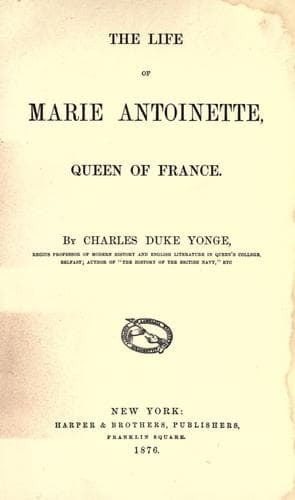
The Life of Marie Antoinette, Queen of FranceYonge, Charles Duke
History
The Life of Marie Antoinette, Queen of France
Yonge, Charles Duke
Marie Antoinette, Queen, consort of Louis XVI, King of France, 1755-1793
tenderness of disposition, though these were never wanting, but also from
a settled principle of duty, which, in her opinion, imposed upon
sovereigns, as a primary obligation, the task of watching over the welfare
of their subjects as persons intrusted by Providence to their care; and
such a feeling was obviously more to be depended upon as a constant motive
for action than the most vivid emotion of the moment, which, if easily
excited, is not unfrequently as easily overpowered by some fresh object.
Meanwhile events were gradually compelling her to take a more active part
in politics. Maurepas had been jealous of her influence, and, while that
old minister lived, Louis, who from his childhood had been accustomed to
see him in office, committed almost every thing to his guidance. But, as
he always required some one of stronger mind than himself to lean upon, as
soon as Maurepas was gone he turned to the queen. It was to her that he
now chiefly confided his anxieties and perplexities; from her that he
sought counsel and strength; and the ministers naturally came to regard
her as the real ruler of the State. Accordingly, we find from her
correspondence of this period that even such matters as the appointment of
the embassadors to foreign states were often referred to her decision; and
how greatly the habit of considering affairs of importance expanded her
capacity we may learn from the opinion which her brother, the emperor, who
was never disposed to flatter, or even to spare her, had evidently come to
entertain of her judgment. In one long letter, written in September of the
year 1783, he discussed with her the attitude which France had assumed
toward Austria ever since the dismissal of Choiseul; the willingness of
her ministers to listen to Prussian calumnies; the encouragement which
they had given to the opposition in the empire; and their obsequiousness
to Prussia; while Austria had not retaliated, as she had had many
opportunities of doing, by any complaisance toward England, though the
English statesmen had made many advances toward her. It is a curious
instance of fears being realized in a sense very different from that which
troubled the writer at the moment, that among the acts of France of which,
had he been inclined to be captious, he might justly have complained, he
enumerates her recent acquisition of Corsica, as one which, "for a number
of reasons, might be very prejudicial to the possessions of the house of
Austria and its branches in Italy." It did indeed prove an acquisition
which largely influenced the future history, not only of Austria, but of
the whole world, when the little island, which hitherto had been but a
hot-bed of disorder, and a battle-field of faction burdensome to its
Genoese masters, gave a general to the armies of France whose most
brilliant exploits were a succession of triumphs over the Austrian
commanders in every part of the emperor's dominion. His letter concludes
Public-domain text, read in full here on John Shaqi.
Reviews
Reviews
No reviews yet
Be the first to share your thoughts on this work.
Elsewhere in the archive
Join the Discussion
Join the discussion
Sign in to leave a comment or review.
Sign InorCreate an account