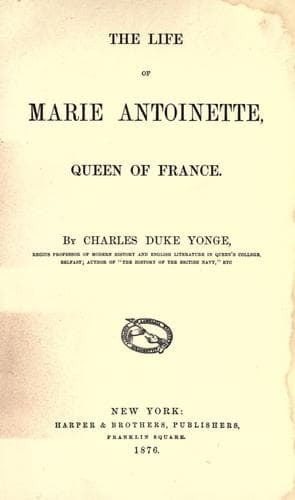
The Life of Marie Antoinette, Queen of FranceYonge, Charles Duke
History
The Life of Marie Antoinette, Queen of France
Yonge, Charles Duke
Marie Antoinette, Queen, consort of Louis XVI, King of France, 1755-1793
"My health, considering my present condition,[2] is perfect. I had a
slight accident after my last letter; but it produced no bad consequences:
it only made a little more care necessary. Accordingly I shall go from
Choisy to Fontainebleau by water. My children are quite well. My boy will
spend his time at La Muette while we are absent. It is just a piece of
stupidity of the doctors, who do not like him to take so long a journey at
his age, though he has two teeth and is very strong. I should be perfectly
happy if I were but assured of the general tranquillity, and, above all,
of the happiness of my much-loved brother, whom I love with all my
heart.[3]"
Another letter, written three months later, explains to the emperor the
object of some of the new arrangements which Calonne had introduced,
having for one object, among others, the facilitation of a commercial
intercourse, especially in tobacco, with the United States. She hopes that
another consequence of them will be the abolition of the whole system of
farmers-general of the revenue; and she explains to him both the
advantages of such a measure, and at the same time the difficulties of
carrying it out immediately after so costly a war, since it would involve
the instant repayment of large sums to the farmers, with all the clearness
of a practiced financier. She mentions also the appointment of the Baron
de Breteuil as the new minister of the king's household,[4] and her
estimate of his character is rendered important by his promotion, six
years later, to the post of prime minister. The emperor also had ample
means of judging of it himself, since the baron had succeeded the Cardinal
de Rohan as embassador at Vienna. "I think, with you, that he requires to
be kept within bounds; and he will be so more than other ministers by the
nature of his office, which is very limited, and entirely under the eyes
of the king and of his colleagues, who will be glad of any opportunities
of mortifying his vanity. However, his activity will be very useful in a
thousand details of a department which has been neglected and badly
managed for the last sixty years." And though it is a slight anticipation
of the order of our narrative, it will not be inconvenient to give here
some extracts from a third letter to the same brother, written in the
autumn of the following year, in which she describes the king's character,
and points out the difficulties which it often interposes to her desire of
influencing his views and measures.
It may perhaps be thought that she unconsciously underrates her influence
over her husband, though there can be no doubt that he was one of those
men whom it is hardest to manage; wholly without self-reliance, yet with a
scrupulous wish to do right that made him distrustful of others, even, of
those whose advice he sought, or whose judgment he most highly valued.
"September 22d, 1784.
Public-domain text, read in full here on John Shaqi.
Reviews
Reviews
No reviews yet
Be the first to share your thoughts on this work.
Elsewhere in the archive
Join the Discussion
Join the discussion
Sign in to leave a comment or review.
Sign InorCreate an account