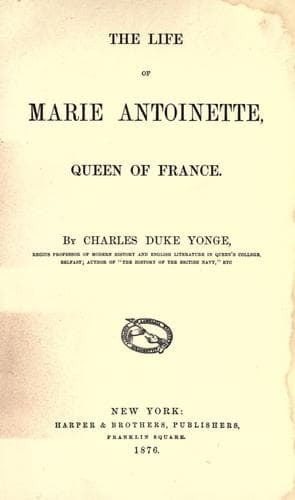
The Life of Marie Antoinette, Queen of FranceYonge, Charles Duke
History
The Life of Marie Antoinette, Queen of France
Yonge, Charles Duke
Marie Antoinette, Queen, consort of Louis XVI, King of France, 1755-1793
The play was entitled "The Marriage of Figaro." The history of the author,
M. Beaumarchais, is curious, as that of a rare specimen of the literary
adventurer of his time. He was born in the year 1732. His father was a
watch-maker named Caron, and he himself followed that trade till he was
three or four and twenty, and attained considerable skill in it. But he
was ambitious. He was conscious of a handsome face and figure, and knew
their value in such a court as that of Louis XV. He gave up his trade as a
watch-maker, and bought successively different places about the court, the
last of which was sold at a price sufficient to entitle him to claim
gentility; so that, in one of his subsequent railings against the nobles,
he declared that his nobility was more incontestable than that of most of
the body, since he could produce the stamped receipt for it. Following the
example of Molière and Voltaire, he changed his name, and called himself
Beaumarchais. He married two rich widows. He formed a connection with the
celebrated financier, Paris Duverney, who initiated him in the mysteries
of stock-jobbing. Being a good musician, he obtained the protection of the
king's daughters, taught them the harp, and conducted the weekly concerts
which, during the life of Marie Leczinska, they gave to the king and the
royal family. He wrote two or three plays, none of which had any great
success, while one was a decided failure. He became involved in lawsuits,
one of which he conducted himself against the best ability of the Parisian
bar, and displayed such wit and readiness that he not only gained his
cause, but established a notoriety which throughout life was apparently
his dearest object. He crossed over to England, where he made the
acquaintance of Wilkes, and one or two agents of the American colonies,
then just commencing their insurrection; and, partly from political
sympathy with their views of freedom, partly, as he declared, to retaliate
on England for the injuries which France had suffered at her hands in the
Seven Years' War, he became a political agent himself, procuring arms and
ships to be sent across the Atlantic, and also a great quantity of stores
of a more peaceful character, out of which he had hoped to make a handsome
profit. But the Americans gave him credit for greater disinterestedness;
the President of Congress wrote him a letter thanking him for his zeal,
but refused to pay for his stores, for which he demanded nearly a hundred
and fifty thousand francs. He commenced an action for the money in the
American courts, but, as he could not conduct it himself, he did not
obtain an early decision; indeed, the matter imbittered all his closing
days, and was not settled when he died.
Public-domain text, read in full here on John Shaqi.
Reviews
Reviews
No reviews yet
Be the first to share your thoughts on this work.
Elsewhere in the archive
Join the Discussion
Join the discussion
Sign in to leave a comment or review.
Sign InorCreate an account