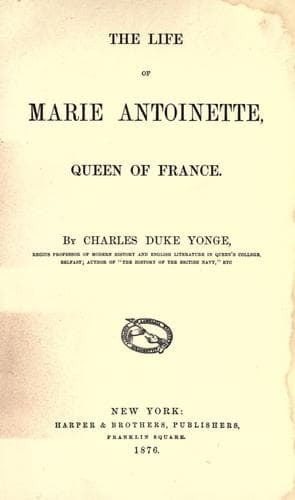
The Life of Marie Antoinette, Queen of FranceYonge, Charles Duke
History
The Life of Marie Antoinette, Queen of France
Yonge, Charles Duke
Marie Antoinette, Queen, consort of Louis XVI, King of France, 1755-1793
The Orleanists and Mirabeau probably knew nothing of this humane or rather
pusillanimous order, though most of the secrets of the court were betrayed
to them; but Mirabeau saw in the arrival of the soldiers a fresh
opportunity of making the king feel the folly of the minister in rejecting
his advances; and in a speech of unusual power he thundered against those
who had advised the bringing-up of troops, as he declared, to overawe the
Assembly; though, in fact, nothing but their presence and active exertions
could prevent the Assembly from being overawed by the mob. But,
undoubtedly, at this time his own first object was to use the populace of
Paris to terrify the members into obedience to himself. In one of his ends
he succeeded; he drove Necker from office. He carried the address which he
proposed, to entreat the king to withdraw the troops; but Louis had for
the moment resolved on adopting bolder counsels than those of Necker. He
declined to comply with the petition, declaring that it was his duty to
keep in Paris a force sufficient to preserve the public tranquillity,
though, if the Assembly were disquieted by their neighborhood, he
expressed his unwillingness to remove their session to some more distant
town. And at the same time he dismissed Necker from office, banishing him
from France, but ordering him to keep his departure secret.
The queen had evidently had great influence in bringing him to this
decision; but how cordially she approved of all the concessions which the
king had already made, and how clearly she saw that more still remained to
be done before the necessary reformation could be pronounced complete, the
letter which on the evening of Necker's dismissal she wrote to Madame de
Polignac convincingly proves. She had high ideas of the authority which a
king was legitimately entitled to exercise; and to what she regarded as
undue restrictions on it, injurious to his dignity, she would never
consent. She probably regarded them as abstract questions which had but
little bearing on the substantial welfare of the people in general; but of
all measures to increase the happiness of all classes, even of the very
lowest, she was throughout the warmest advocate.
"July 11th, 1789.
Public-domain text, read in full here on John Shaqi.
Reviews
Reviews
No reviews yet
Be the first to share your thoughts on this work.
Elsewhere in the archive
Join the Discussion
Join the discussion
Sign in to leave a comment or review.
Sign InorCreate an account