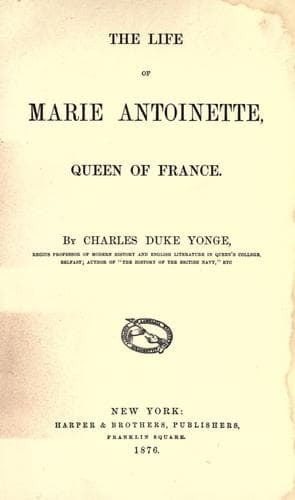
The Life of Marie Antoinette, Queen of FranceYonge, Charles Duke
History
The Life of Marie Antoinette, Queen of France
Yonge, Charles Duke
Marie Antoinette, Queen, consort of Louis XVI, King of France, 1755-1793
Though he could not avoid seeing the mischievous character of many of the
resolutions thus tumultuously passed, and though his royal assent to them
was asked in language unceremonious and almost peremptory in its curtness,
Louis could not bring himself, or perhaps did not venture, to refuse his
sanction to them. He had laid down a rule for himself to refuse no
concession except such as on religious grounds his conscience might revolt
from; and on the 18th he signified his formal acceptance of the
resolutions, and of the title of "Restorer of French Liberty." It was an
act of great weakness, and was rewarded, as such acts generally are, by
further encroachments on his authority. The progress of the Left was not
even arrested by a quarrel between some of its members (who, being
clergymen, were not inclined to be reduced to beggary by the extinction of
their incomes), and Mirabeau, who, not unnaturally, bore the priests
especial ill-will. Before the end of the month, the Assembly even deprived
the king of the power of withholding his assent from measures which it
might pass, enacting that he should no longer possess an absolute "veto,"
as it was called, and Necker, exhibiting on this question an incapacity
more glaring than even his former conduct had displayed, induced the king
to yield this point also; and to express his own preference for what its
contrivers called a suspensive veto--a power, that is, of withholding his
assent to any measure till it had been passed by two successive
Assemblies. The discussions on this most momentous point had been very
vehement in the Assembly itself; and, besides the greatness of the
principle involved in the decision, they have a peculiar importance as
showing that Mirabeau had not the absolute power over the minds of the
members which he believed himself to possess; since he contended with all
the energy of his temper, and with irresistible force of argument, against
a vote which, as he declared, could only take the power from the king to
vest it in the Assembly, and yet was wholly unable to carry more than a
small minority with him in his opposition.
Public-domain text, read in full here on John Shaqi.
Reviews
Reviews
No reviews yet
Be the first to share your thoughts on this work.
Elsewhere in the archive
Join the Discussion
Join the discussion
Sign in to leave a comment or review.
Sign InorCreate an account