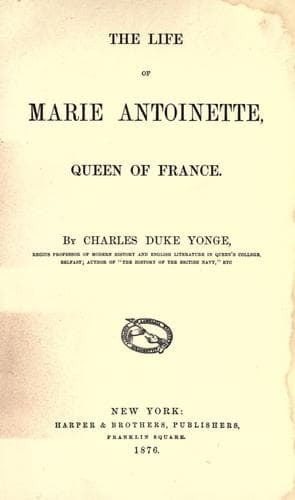
The Life of Marie Antoinette, Queen of FranceYonge, Charles Duke
History
The Life of Marie Antoinette, Queen of France
Yonge, Charles Duke
Marie Antoinette, Queen, consort of Louis XVI, King of France, 1755-1793
And a day or two later, on the 10th, even while giving fuller expression
to her feelings of unhappiness, and of disgust at the events of the past
week, as to which she assures Mercy that "no description could be
exaggerated; on the contrary, that any account must fall far short of what
the king and she had seen and experienced," she yet repeats that "she
hopes to bring back to a right feeling the honest and sound portion of the
citizens and people. Unhappily, however," as she adds, "they are not the
most numerous body. Still, with gentleness and unwearied patience, she may
hope that at least she shall succeed in doing away with the horrible
distrust which occupies every mind, and which has dragged the king and
herself into the gulf in which they are at present." So keen at this time
was her feeling that one principal cause of their miseries was the unjust
distrust which the citizens in general conceived of the views and designs
of the court, that she desires Mercy not to try to see her; and, while she
describes the scantiness of the accommodation which her attendants had as
yet been able to provide for her, so that Madame Royale had a bed in her
dressing-room, and the little dauphin was in her own room, she finds
advantage in these arrangements, inconvenient as they were, since they
prevented any suspicion from arising that she was giving audiences which
she desired to keep secret.
She did not overrate the impression which she had made on the people; and
her faithful attendant, Madame Campan, has preserved more minute details
of the events of the 7th than she herself reported to the embassador. She
was hardly dressed when a huge crowd collected on the terrace under her
window, shouting for her to show herself; and, when she came forward, they
began to accost her in a mingled tone of expostulation and menace. "She
must drive away the courtiers who were the ruin of kings. She must love
the inhabitants of her good city." She replied "that she had always felt
so toward them; she had loved them while at Versailles; she should
continue to love them at Paris." "Ah," interrupted a virago, hardier than
her companions, "but on the 14th of July you would have besieged and
bombarded the city; and on the 6th of October you wanted to flee to the
frontier." She answered, in the gentlest tone, that "these were idle
stories, which they were wrong to believe; tales like these were what
caused at once the misery of the people and that of the best of kings."
Another woman addressed her in German. Marie Antoinette declared that "she
did not understand what she said; that she had become so completely French
that she had forgotten her native language;" and the compliment to their
country fairly vanquished them. They received it with shouts of "Bravo,"
and with loud clapping of their hands. They begged the ribbons and flowers
of her bonnet. She took them off with her own hand and distributed them
Public-domain text, read in full here on John Shaqi.
Reviews
Reviews
No reviews yet
Be the first to share your thoughts on this work.
Elsewhere in the archive
Join the Discussion
Join the discussion
Sign in to leave a comment or review.
Sign InorCreate an account