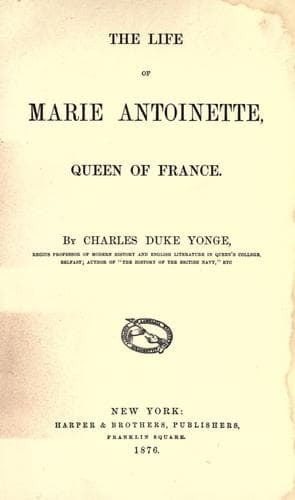
The Life of Marie Antoinette, Queen of FranceYonge, Charles Duke
History
The Life of Marie Antoinette, Queen of France
Yonge, Charles Duke
Marie Antoinette, Queen, consort of Louis XVI, King of France, 1755-1793
But in the next month the Assembly dealt a heavier blow on the king's
authority than could be inflicted by the worst excesses of an informal
mob--they passed a resolution prohibiting any of its members from
accepting any office in the administration: it was an imitation of the
self-denying ordinance into which Cromwell had tricked the English
Parliament; and, though bearing an appearance of disinterestedness in
closing the access to official emoluments and honors against themselves,
was in reality an injury to the king, as depriving him of his right to
select his ministers from the entire body of the nation; and to the nation
itself, as preventing it from obtaining the services of those who might be
presumed to be its ablest citizens, as having been already selected as its
representatives.
But a far more irreparable injury than any that could be inflicted on the
court by either populace or Assembly came from its friends. We have seen
that the Count d'Artois, with some nobles who had especial reason to fear
the enmity of the Parisians, had fled from the country in July; and now
their example was followed by a vast number of the higher classes, several
of them having hitherto been prominent as the leaders of the Moderate or
Constitutional section of the Assembly--men who had no grounds for
complaining that, except in one or two instances, at moments of
extraordinary excitement, their influence had been overborne, but who now
yielded to an infectious panic. Before the end of the year more than three
hundred deputies had resigned their seats and quit the country; salving
over to themselves the dereliction of the duties which a few months before
they had voluntarily sought, and their performance of which was now a more
imperative duty than ever, by denunciations of the crimes which had been
committed, and which they had found themselves unable to prevent. They did
not see that their pusillanimous flight must lead to a continuance of such
atrocities, leaving, as it did, the undisputed sway in the Assembly to
those very men who had been the authors of the outrages of which they
complained. They were, in fact, insuring the ruin of all that they most
wished to preserve; for, in the progress of the debates in the Assembly
during the winter, many questions of the most vital importance were
decided by very small majorities, which their presence would have turned
into minorities. The greater the danger was, the more irresistible they
ought to have felt the obligation to stand to the last by the cause of
which they were the legitimate champions; and the final triumph of the
Jacobin party owed hardly more to the energy of its leaders than to the
cowardly and inglorious flight of the princes and nobles who left the
field open without resistance to their wickedness and audacity.
Public-domain text, read in full here on John Shaqi.
Reviews
Reviews
No reviews yet
Be the first to share your thoughts on this work.
Elsewhere in the archive
Join the Discussion
Join the discussion
Sign in to leave a comment or review.
Sign InorCreate an account