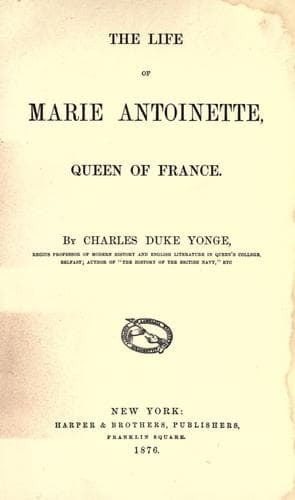
The Life of Marie Antoinette, Queen of FranceYonge, Charles Duke
History
The Life of Marie Antoinette, Queen of France
Yonge, Charles Duke
Marie Antoinette, Queen, consort of Louis XVI, King of France, 1755-1793
And many of the recent events had convinced him that there was no time to
lose. The vote of November, debarring him, in common with all other
members of the Assembly, from office, was a severe blow to the most
important of his projects, so far as his own interests were concerned.
Within a month it had been followed by another, proposed by the Abbé
Siéyes, a busy priest who boasted that he had made himself master of the
whole science of politics, but who was in fact a mere slave of abstract
theories, the safety or even the practicability of which he was utterly
unable to estimate. On his motion, the Assembly, in a single evening,
abolished all the ancient territorial divisions of the kingdom, and the
very names of the provinces; dividing the country anew into eighty-three
departments, and coupling with this new arrangement a number of details
which were evidently calculated to wrest the whole executive authority of
the kingdom from the crown and to vest it in the populace. At another
sitting, the whole property of the Church was confiscated. On another
night, the Parliaments were abolished; and on a fourth, the party which
had carried these measures made a still more direct and audacious attack
on the royal prerogative, by passing a resolution which deprived the crown
of all power of revising the sentences of the judicial tribunals, and of
pardoning or mitigating the punishment of those who might have been
condemned. And, if to bring home to the tender-hearted monarch the full
effect of this last inroad upon his legitimate power, they at the same
time created a new crime to which they gave the name of treason against
the nation,[12] without either defining it, or specifying the kind of
evidence which should he required to prove it; and they proceeded at once
to put it in force to procure the condemnation of a nobleman of decayed
fortune, but of the highest character, the Marquis de Favras, in a manner
which showed that their real object was to strike terror into the whole
Royalist party. The charges on which he was brought to trial were not
merely unfounded, but ridiculous. He was charged with designing to raise
an army of thirty thousand men, with the object of carrying off the king
from Paris, of dissolving the Assembly by force, and putting La Fayette
and Bailly to death. The evidence with which it was pretended to support
these charges broke down on every point, and its failure of itself
established the prisoner's innocence, even without the aid of his own
defense, which was lucid and eloquent. But the marquis was known to be a
Royalist in feeling, and, though very poor, to stand high in the
confidence of the princes. The demagogues collected mobs round the
courthouse to intimidate the judges, and the judges proved as base as the
accusers themselves. They professed, indeed, to fear not so much for their
own lives as for the public tranquillity, but they pronounced him guilty.
Public-domain text, read in full here on John Shaqi.
Reviews
Reviews
No reviews yet
Be the first to share your thoughts on this work.
Elsewhere in the archive
Join the Discussion
Join the discussion
Sign in to leave a comment or review.
Sign InorCreate an account