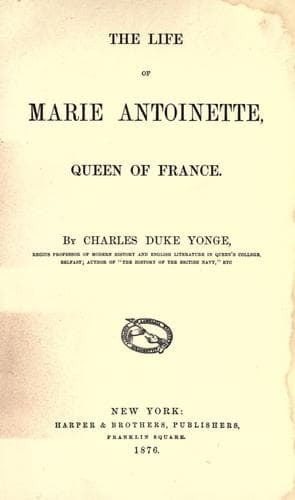
The Life of Marie Antoinette, Queen of FranceYonge, Charles Duke
History
The Life of Marie Antoinette, Queen of France
Yonge, Charles Duke
Marie Antoinette, Queen, consort of Louis XVI, King of France, 1755-1793
To apply such language to the adherence of a French noble to the crown was
the most open avowal of disloyalty on which the revolutionary party had
yet ventured; and in the next four weeks it received a practical
development in a series of measures, some of which were so ridiculous as
only to deserve notice from the additional evidence which they furnished
of the extreme folly of those who now had the lead in the Assembly, and of
the strange excitement in which the whole nation, or at least the whole
population of Paris, must have been wrought up before they could mistake
their acts for those of sagacity or patriotism; but others of which,
though not less unwise, were of greater importance as being irrevocable
steps in the downward course of destruction along which the whole country
was being dragged.
The leaders of the revolutionary party had already selected two days in
the past year as especially memorable for the triumphs won over the crown:
one was the 20th of June, on which, in the Tennis Court at Versailles, the
members of the Assembly had bound themselves to effect the regeneration of
the kingdom; the other the 14th of July, on which, as they boasted, they
had forever established freedom by the destruction of the Bastile; and
they determined this year to celebrate both these anniversaries in a
becoming manner. Accordingly, on the 20th of June, a crack-brained member
of the Jacobin Club, a Prussian of noble birth, named Clootz, who, to show
his affinity with the philosophers of old, had assumed the name of
Anacharsis, hired a band of vagrants and idlers, and, dressing them up in
a variety of costumes to represent Arabs, red Indians, Turks, Chinese,
Laplanders, and other tribes, savage and civilized, led them into the
Assembly as a deputation from all the nations of the earth to announce the
resurrection of the whole world from slavery; and demanded permission for
them to attend the festival of the ensuing month, that each, on behalf of
his country, might give in his adhesion to the principles of liberty as
expounded by the Assembly. The president of the day replied with an
oration thanking M. Clootz for the honor done to France by such an
embassy; and Alexander Lameth followed up the president's harangue by
fresh praises of the deputation as holy pilgrims who had thrown off the
shackles of superstition. Nor was he content with a barren panegyric. He
had devised an appropriate sacrifice with which to commemorate such
exalted virtue. In the finest square of the city, the Place des Victoires,
the Duke de la Feuillade had erected a statue of Louis XIV. to celebrate
his royal master's triumphs, the pedestal of which was decorated with
allegorical representations of the nations which had been conquered by the
French marshals. It was generally regarded as the finest work of art in
the city, and as such it had long been an object of admiration and pride
to the citizens. But M. Lameth, in his new-born enthusiasm, regarded it
Public-domain text, read in full here on John Shaqi.
Reviews
Reviews
No reviews yet
Be the first to share your thoughts on this work.
Elsewhere in the archive
Join the Discussion
Join the discussion
Sign in to leave a comment or review.
Sign InorCreate an account