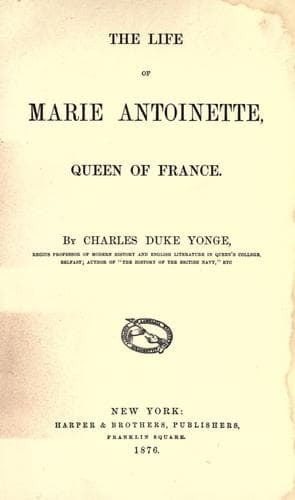
The Life of Marie Antoinette, Queen of FranceYonge, Charles Duke
History
The Life of Marie Antoinette, Queen of France
Yonge, Charles Duke
Marie Antoinette, Queen, consort of Louis XVI, King of France, 1755-1793
Marie Antoinette, however, paid but little attention to these ministerial
changes; she disregarded them--and her view was not unsound--as but the
displacement of one set of weak men by another set equally weak; and she
saw, too, that the Assembly had established so complete a mastery over the
Government, that even men of far greater ability and force of character
would have been impotent for good. Her whole dependence was on Mirabeau;
and his course at this time was so capricious and erratic that it often
caused her more perplexity and alarm than pleasure or confidence. He
regarded himself as having a very difficult part to play. He could not
conceal from himself that he was no longer able to lead the Assembly as he
had done at first, except when he was urging it along a road which it
desired to take. In spite of one of his most brilliant efforts of
eloquence, he had recently been defeated in an endeavor to preserve to the
king the right of peace and war; and, to regain his ascendency, he more
than once in the course of the autumn supported measures to which the king
and queen had the greatest repugnance, and made speeches so inflammatory
that even his own friend, La Marck, was indignant at his language, and
expostulated with him with great earnestness. He justified himself by
explaining his view[10] that no man in the country could at present bring
the people back to reasonable notions; that they could only at this moment
be governed by flattering their prejudices; that the king must trust to
time alone; and that his own sole prospect of being of use to the crown
lay in his preservation of his popularity till the favorable moment should
arrive, even if, to preserve that popularity, it were necessary for him at
times still to appear a supporter of revolutionary principles. It is not
impossible that the motives which he thus described did really influence
him; but it was not strange that Marie Antoinette should fail to
appreciate such refined subtlety. She had looked forward to his taking a
bold, straightforward course in defense of Royalist principles; and she
could hardly believe in the honesty of a man who for any object whatever
could seem to disregard or to despise them. Her feelings may be shown by
some extracts from one of her letters to the emperor written just after
one of Mirabeau's most violent outbursts, apparently his speech in support
of a motion that the fleet should be ordered to hoist the tricolor flag.
"October 22d, 1790.
Public-domain text, read in full here on John Shaqi.
Reviews
Reviews
No reviews yet
Be the first to share your thoughts on this work.
Elsewhere in the archive
Join the Discussion
Join the discussion
Sign in to leave a comment or review.
Sign InorCreate an account