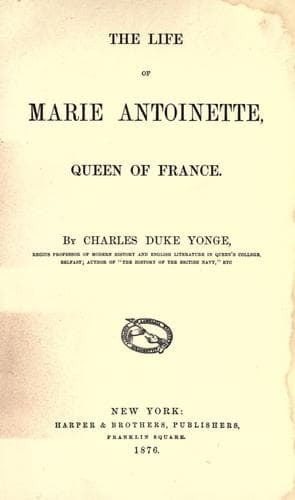
The Life of Marie Antoinette, Queen of FranceYonge, Charles Duke
History
The Life of Marie Antoinette, Queen of France
Yonge, Charles Duke
Marie Antoinette, Queen, consort of Louis XVI, King of France, 1755-1793
Marie Antoinette, as we have seen, had been anxious that their departure
from Paris should not be delayed beyond the end of May, and De Bouillé had
agreed with her; but enterprises of so complicated a character can rarely
be executed with the rapidity or punctuality that is desired, and it was
not till the 20th of June that this movement, on which so much depended,
was able to be put in execution. Often during the preceding weeks the
queen's heart sunk within her when she reflected on the danger of
discovery, whether from the acuteness of her enemies or the treachery of
pretended friends; and even more when she pondered on the character of the
king himself, so singularly unfitted for an undertaking in which it was
not the passive courage with which he was amply endowed, but daring
resolution, promptitude, and presence of mind, which were requisite. She
was cheered, however, by repeated letters from the emperor, showing the
warm and affectionate interest which he took in the result of the
enterprise, and promising with evident sincerity "his own most cordial
co-operation in all that could tend to her and her husband's success,
when the time should come for him to show himself."
But her main reliance was on herself; and all who were privy to the
enterprise knew well that it was on her forethought and courage that its
success wholly depended. Those who were privy to it were very few; and it
is a singular proof how few Frenchmen, even of the highest rank, could be
trusted at this time, that of these few two were foreigners--a Swede, the
Count de Fersen, whose name has been mentioned in earlier chapters of this
narrative, and (an English writer may be proud to add) an Englishman, Mr.
Craufurd. In such undertakings the simplest arrangements are the safest;
and those devised by the queen and her advisers, the chief of whom were De
Fersen and De Bouillé, were as simple as possible. The royal fugitives
were to pass for a traveling party of foreigners. A passport signed by M.
Montmorin, who still held the seals of the Foreign Department, was
provided for Madame de Tourzel, who, assuming the name of Madame de Korff,
a Russian baroness, professed to be returning to her own country with her
family and her ordinary equipage. The dauphin and his sister were
described as her children, the queen as their governess; while the king
himself, under the name of Durand, was to pass as their servant. Three of
the old disbanded Body-guard, MM. De Valory, De Malden, and De Moustier,
were to attend the party in the disguise of couriers; and, under the
pretense of providing for the safe conveyance of a large sum of money
which was required for the payment of the troops, De Bouillé undertook to
post a detachment of soldiers at each town between Châlons and Montmédy,
through which the travelers were to pass.
Public-domain text, read in full here on John Shaqi.
Reviews
Reviews
No reviews yet
Be the first to share your thoughts on this work.
Elsewhere in the archive
Join the Discussion
Join the discussion
Sign in to leave a comment or review.
Sign InorCreate an account