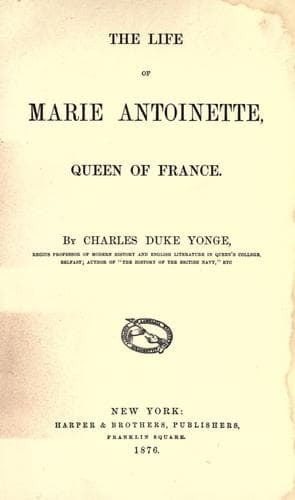
The Life of Marie Antoinette, Queen of FranceYonge, Charles Duke
History
The Life of Marie Antoinette, Queen of France
Yonge, Charles Duke
Marie Antoinette, Queen, consort of Louis XVI, King of France, 1755-1793
The great writer was, as in more than one other instance of his career,
too earnest in his conviction that principles were at stake in the course
which he recommended, to consider whether that course were safe for those
on whom he urged it, or even practicable. But Marie Antoinette, as one on
whose decision the very lives of her husband and her child might depend,
felt bound to consider, in the first place, how far her adoption of the
advice thus tendered might endanger both; and, accordingly, while
expressing to Mercy the full extent of her repugnance to the system of
government, if indeed it deserved the name of a system, which the new
Constitution had framed, she shows that her disapproval of it has in no
degree led her to change her mind on the practical question of the course
which the king should pursue. She justifies her decision to Mercy in a
most elaborate letter, in which the whole position is surveyed with
admirable good sense.[8]
"Our position is this: We are now on the point of having the Constitution
brought to us for acceptance. It is in itself so monstrous that it is
impossible that it should be long maintained. But, in the position in
which we are, can we risk refusing it? No; and I will prove it to you. I
am not speaking of the personal dangers which we should run. We have fully
shown by the journey which we undertook two months ago that we do not take
our own safety into account when the public welfare is at stake. But this
Constitution is so intrinsically bad that it can only acquire consistence
from any resistance which we might oppose to it. Our business, therefore,
is to take a middle course, which may save our honor, and may put us in
such a position that the people may come back to us when once their eyes
are opened, and they have become weary of the existing state of affairs. I
think also that it is necessary that, when they have presented the act to
the king, he should keep it by him a few days; for he is not supposed to
know what it is till it has been presented to him in all legal form; and
that then he should summon the Commissioners before him, not to make any
comments, not to demand any alterations, which perhaps might not be
admitted, and which would be interpreted as an admission that he approved
of the basis, but to declare that his opinions are not changed; that, in
his declaration of the 20th of June,[9] he proved the absolute
impossibility of governing under the new system, and that he is still of
the same mind; but that, for the sake of the tranquillity of his country,
he sacrifices himself; and that, as his people and the nation stake their
happiness on his accepting it, he does not hesitate to signify that
acceptance; and that the sight of their happiness will speedily make him
forget the cruel and bitter griefs which they have inflicted on him and on
his family.
Public-domain text, read in full here on John Shaqi.
Reviews
Reviews
No reviews yet
Be the first to share your thoughts on this work.
Elsewhere in the archive
Join the Discussion
Join the discussion
Sign in to leave a comment or review.
Sign InorCreate an account