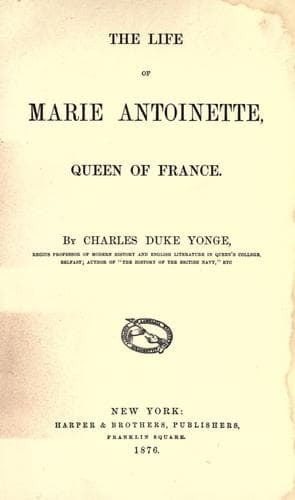
The Life of Marie Antoinette, Queen of FranceYonge, Charles Duke
History
The Life of Marie Antoinette, Queen of France
Yonge, Charles Duke
Marie Antoinette, Queen, consort of Louis XVI, King of France, 1755-1793
As none of them had any force of character, they fell under the influence
of the wife of one of their number, a small manufacturer, named Roland,
the same who, as we have already seen, was the first to raise the cry of
blood in France, and to recommend the assassination of the king and queen
while they were still in fancied security at Versailles. Under the
direction of this fierce woman, whose ferocity was rendered more
formidable by her undoubted talents, the Girondins began an internecine
war with the king, who had refused them the wages which they had asked.
They planned and carried out the sanguinary attacks on the palace in the
summer of the next year. They brought Louis to the scaffold by the
unanimity of their votes. Yet it would have been more fortunate for
themselves as well as for him had they been less exorbitant in their
demands, and had they connected themselves with the Government as they
desired. For though they succeeded in their treason, though Madame Roland
saw the accomplishment of her wish in the murder of the king and queen,
their success was equally fatal to themselves. Almost all of them perished
on the same scaffold to which they had consigned their virtuous
sovereigns, meeting a fate in one respect worse even than theirs, from the
infamy of the names which they have left behind them.
Yet for a few days it seemed as if their malignity would miss its aim.
They did not wait a single day before displaying it; but, at the
preliminary meeting of the Assembly, before it was opened for the dispatch
of business, Vergniaud proposed to declare it illegal to speak of the king
as his majesty, or to address him as "sire;" while another deputy, named
Couthon, who at first belonged to the same party, though he afterward
joined the Jacobins, carried a motion that, when Louis came to open the
Assembly, the president should occupy the place of honor, and the second
seat should be allotted to the sovereign.
Still, for a moment it seemed as if they had overshot their mark, and as
if the more loyal party would be able to withstand and defeat them. The
Assembly itself was compelled to repeal its recent votes, since Louis,
whom indignation for once inspired with greater firmness than he usually
displayed, refused to open the new Assembly in person unless he were to be
received with the honors to which his rank entitled him. The offensive
resolutions were canceled; and, when he had therefore opened the session
in a dignified and conciliatory speech which was chiefly of his own
composition, the president, M. Pastoret, a member of the Constitutional
party, replied in a language which was not only respectful, but
affectionate. The Constitution, he said, had given the king friends in
those who were formerly only styled his subjects. The Assembly and the
nation felt the need of his love. As the Constitution had rendered him the
greatest monarch in the world, so his attachment to it would place him
among the kings most beloved by their people.
Public-domain text, read in full here on John Shaqi.
Reviews
Reviews
No reviews yet
Be the first to share your thoughts on this work.
Elsewhere in the archive
Join the Discussion
Join the discussion
Sign in to leave a comment or review.
Sign InorCreate an account