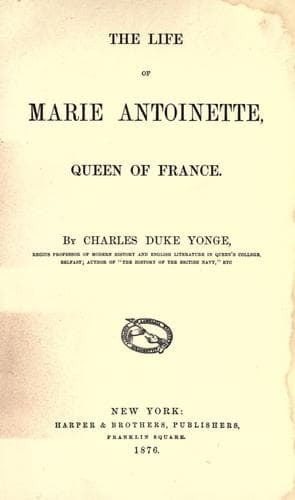
The Life of Marie Antoinette, Queen of FranceYonge, Charles Duke
History
The Life of Marie Antoinette, Queen of France
Yonge, Charles Duke
Marie Antoinette, Queen, consort of Louis XVI, King of France, 1755-1793
Still, these sweeping proscriptions of entire classes were not yet to the
taste of the nation. Petitions from the country, and even one from the
department of the Seine, were presented to Louis, begging him to refuse
his assent to the decree against the priests; and the feeling which they
represented was so strong, and the reputation of some of the petitioners
stood so high for ability and influence, that the ministers believed that
he could safely refuse his sanction to both the votes. Even without their
advice he would have rejected the decree against the priests, as one
absolutely incompatible with his reverence for religion and its ministers;
and his conduct on this subject supplies one more striking parallel to the
history of the great English rebellion; since there can hardly be a more
precise resemblance between events occurring in different ages and
different countries than is afforded by the resistance made by Charles to
the last vote of the London Parliament against the bishops, and this
resistance of Louis to the will of the Assembly on behalf of the priests,
and by the fatal effect which, in each case, their conscientious and
courageous determination had upon the fortunes of the two sovereigns.
Louis therefore put his veto on both the decrees, with the exception of
that clause in the act against the emigrants which summoned his brothers
to return to the kingdom. But, that no one might pretend to fancy that he
either approved of the conduct of the emigrants or sympathized with their
principles or designs, he issued a circular letter to the governors of the
different sea-ports, in which he remonstrated most earnestly with the
sailors, numbers of whom, as it was reported in Paris, were preparing to
follow their example. He pointed out in it that those who thus deserted
their country mistook their duty to that country, to him as their king,
and to themselves; that the present aspect of the nation, desirous to
return to order and to submission to the law, removed every pretext for
such conduct. He set before them his own example, and bid them remain at
their posts, as he was remaining at his; and, in language more impressive
than that of command, he exhorted them not to turn a deaf ear to his
prayers; and at the same time he addressed letters to the electors of
Trèves and Mayence, and to the other petty German princes whose
territories, bordering on the Rhine, were the principal resort of the
emigrants, requiring them to cease to give them shelter, and announcing
that if they should refuse to remove them from their dominions he should
consider their refusal a sufficient ground for war; while, to show that he
did not intend this menace to be a dead letter, he soon afterward
announced to the Assembly that he had ordered a powerful army of a hundred
and fifty thousand men to be moved toward the frontier, under the command
of Marshal Luckner, Marshal Rochambeau, and General La Fayette, and he
Public-domain text, read in full here on John Shaqi.
Reviews
Reviews
No reviews yet
Be the first to share your thoughts on this work.
Elsewhere in the archive
Join the Discussion
Join the discussion
Sign in to leave a comment or review.
Sign InorCreate an account