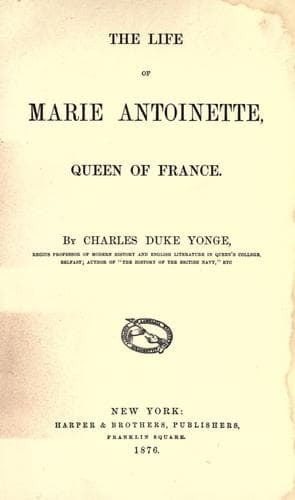
The Life of Marie Antoinette, Queen of FranceYonge, Charles Duke
History
The Life of Marie Antoinette, Queen of France
Yonge, Charles Duke
Marie Antoinette, Queen, consort of Louis XVI, King of France, 1755-1793
The ministers fell before Vergniaud, and the unhappy king had no resource
but to choose their successors from the party which had triumphed over
them. The absurd law by which the last Assembly had excluded its members
from office was still in force, so that the orator himself and his
colleagues could obtain no personal promotion; but they were able to
nominate the new ministers, who, with but one exception, were all men
equally devoid of ability and reputation, and therefore were the better
fitted to be the tools of those to whom they owed their preferment. The
names of three were Lacoste, Degraves, and Duranton, of whom nothing
beyond their names is known. A fourth was Roland, who was indeed known,
though not for any abilities of his own, but as the husband of the woman
who, as has been already mentioned, was the first person in the whole
nation to raise the cry for the murder of the king and queen, and whose
fierce thirst for blood so predominated over every other feeling that a
few weeks afterward she even began to urge the assassination of the only
one among her husband's colleagues who was possessed of the slightest
ability because his views did not altogether coincide with her own.
General Dumouriez, whom she thus honored by singling him out for her
especial hatred, was an exception to his colleagues in several points. He
was a man of middle age, who enjoyed a good reputation, not only for
military skill, but also for diplomatic sagacity and address, earned as
far back as the latter years of the preceding reign; and he was so far
from being originally imbued with revolutionary principles that, when, in
the summer of 1789, a mutinous spirit first appeared among the troops in
Paris, he volunteered to place his services at the king's disposal,
recommending measures of vigor and resolution, which, if they had been
adopted, might have quelled the spirit of rebellion, and have changed the
whole subsequent history of the nation. But as Necker had rejected
Mirabeau a few weeks before, so he also rejected Dumouriez; and discontent
at the treatment which he received from the minister, and which seemed to
prove that active employment, of which he was desirous, could only be
obtained through some other influence, drove the general into the ranks of
the Revolutionary party. He now accepted the post of foreign secretary in
the new ministry; but the connection with the enemies of the monarchy was
uncongenial to his taste; and, after a short time, the frequent
intercourse with Louis, which was the necessary consequence of his
appointment, and the conviction of the king's perfect honesty and
patriotism which this intercourse forced upon him, revived his old
feelings of loyalty, and, so long as he remained in office, he honestly
endeavored to avert the evils which he foresaw, and to give the advice and
to support the policy by which, in his honest belief, it was alone
possible for Louis to preserve his authority.
Public-domain text, read in full here on John Shaqi.
Reviews
Reviews
No reviews yet
Be the first to share your thoughts on this work.
Elsewhere in the archive
Join the Discussion
Join the discussion
Sign in to leave a comment or review.
Sign InorCreate an account