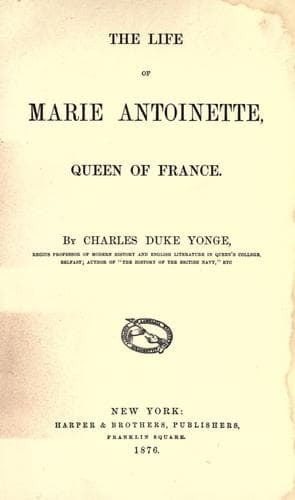
The Life of Marie Antoinette, Queen of FranceYonge, Charles Duke
History
The Life of Marie Antoinette, Queen of France
Yonge, Charles Duke
Marie Antoinette, Queen, consort of Louis XVI, King of France, 1755-1793
At this moment she was especially happy with a new pastime. Amidst the
stately halls of Versailles she had often longed for a villa on a smaller
scale, which she might call her own; and the wish was now gratified. On
one side of the park of Versailles, and about a mile from the palace, the
late king had built an exquisite little pavilion for his mistress, which
was known as the Little Trianon. There had been a building of one kind or
another on the same spot for above a century. Louis XIV. had erected there
a cottage of porcelain for his imperious favorite, Madame de Montespan;
and it was the more sumptuous palace with which, after her death, he
replaced it, that gave rise to the strange quarrel between the haughty
monarch and his equally haughty minister, Louvois, of which St. Simon has
left us so curious an account.[2] This had been allowed to fall into a
state of decay; and a few years before his death, Louis XV. had pulled
down what remained of it, and had built a third on its foundations, which
had been the most favorite abode of Madame du Barri during his life, but
which was now rendered vacant by her dismissal. The house was decorated
with an exquisite delicacy of taste, in which Louis XV. had far surpassed
his predecessor; but the chief charm of the place was generally accounted
to be the garden, which had been laid out by Le Notre, an artist, whose
original genius as a landscape gardener was regarded by many of his
contemporaries as greatly superior to his more technical skill as an
architect.[3]
A few hundred yards off was another palace, the Great Trianon; but it was
the Little Trianon which caught the queen's fancy; and, on her expression
of a wish to have it for her own, the king at once made it over to her;
and, pleased with her new toy, Marie Antoinette, still a girl in her
impulsive eagerness for a fresh pleasure (she was not yet nineteen), began
to busy herself with remodeling the pleasure-grounds with which it was
surrounded. Before the time of Le Notre, the finest gardens in the country
had been laid out on what was called the Italian plan. He was too good a
patriot to copy the foreigners: he drove out the Italians, and introduced
a new arrangement, known as the French style, which was, in fact, but an
imitation of the stiff, formal Dutch mode. But of late the English
gardeners had established that supremacy in the art which they have ever
since maintained; and the present aim of every fashionable horticulturist
in France was to copy the effects produced on the banks of the Thames by
Wise and Browne.
Public-domain text, read in full here on John Shaqi.
Reviews
Reviews
No reviews yet
Be the first to share your thoughts on this work.
Elsewhere in the archive
Join the Discussion
Join the discussion
Sign in to leave a comment or review.
Sign InorCreate an account