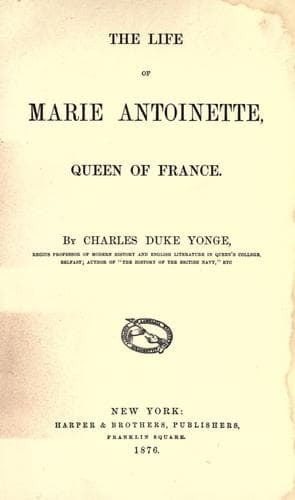
The Life of Marie Antoinette, Queen of FranceYonge, Charles Duke
History
The Life of Marie Antoinette, Queen of France
Yonge, Charles Duke
Marie Antoinette, Queen, consort of Louis XVI, King of France, 1755-1793
to wipe his fingers and filled his glass; ladies in waiting in the same
grand attire changed the plates of the royal pair; and after dinner, as
indeed throughout the day, the queen could not quit one room in the
palace for another, unless some of her ladies were at hand in complete
court dress to attend upon her.[5] These usages, which were in reality
so many chains to restrain all freedom, and to render comfort
impossible, were abolished in the first few months of the new reign;
but, little as was the foundation which they had in common sense, and
equally little as was the addition which they made to the royal dignity,
it is certain that many of the courtiers, besides Madame de Noailles,
were greatly disconcerted at their extinction. They regarded the queen's
orders on the subject as a proof of a settled preference for Austrian
over French fashions. They began to speak of her as "the Austrian," a
name which, though Madame Adelaide had more than once chosen it to
describe her during the first year of her marriage, had since that time
been almost forgotten, but which was now revived, and was continually
reproduced by a certain party to cast odium on many of her most simple
tastes and most innocent actions. Her enemies oven affirmed that in
private she was wont to call the Trianon her "little Vienna,[6]" as if
the garden, which she was laying out with a taste that long made it the
admiration of all the visitors to Versailles, were dear to her, not as
affording a healthful and becoming occupation, nor for the sale of the
giver, but only because it recalled to her memory the gardens of
Schönbrunn, to which, as their malice suggested, she never ceased to
look back with unpatriotic regret.
In one point of view they were unquestionably correct. The queen did
undoubtedly desire to establish in the French court the customs and the
feelings which, during her childhood, had prevailed at Vienna; but they
were wholly wrong in thinking them Austrian usages. They were Lorrainese
in their origin; they had been imported to Vienna for the first time by
her own father, the Emperor Francis; when she referred to them, it was as
"the patriarchal manners of the House of Lorraine[7]" that she spoke of
them; and her preference for them was founded on the conviction that it
was to them that her mother and her mother's family were indebted for the
love and reverence of the people which all the trials and distresses of
the struggle against Frederic had never been able to impair.
Public-domain text, read in full here on John Shaqi.
Reviews
Reviews
No reviews yet
Be the first to share your thoughts on this work.
Elsewhere in the archive
Join the Discussion
Join the discussion
Sign in to leave a comment or review.
Sign InorCreate an account