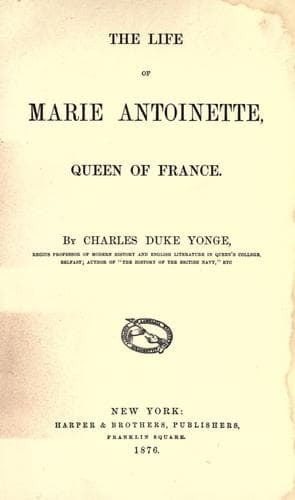
The Life of Marie Antoinette, Queen of FranceYonge, Charles Duke
History
The Life of Marie Antoinette, Queen of France
Yonge, Charles Duke
Marie Antoinette, Queen, consort of Louis XVI, King of France, 1755-1793
And so it was generally found to be; for, with the exception of an
occasional fancy for some splendid jewel, Marie Antoinette had no
expensive tastes. Her economy was even far greater than her attendants
approved, extending to details which they would have wished her to regard
as beneath the dignity of a sovereign;[1] and so judiciously did she
manage her resources that she was able to defray out of her privy purse
the pensions which she occasionally conferred on men eminent in arts or
literature, whom she rightly judged it a royal duty to encourage.
One of her first acts of liberality of this kind was exercised in favor of
a countryman of her own, the celebrated Gluck. Music was one of her most
favorite accomplishments. She still devoted a portion of almost every day
in taking lessons on the harp; but the French music was not to her taste;
while, since the death of Handel, Gluck's superiority to all his other
musical contemporaries had been generally acknowledged in all countries.
She now, by the gift of a pension of 6000 francs, induced him to visit
Paris. It was at the French opera that many of his most celebrated works
were first given to the world; and an incident which took place at the
performance of one of them showed that, if the frequenters of Versailles
were dissatisfied at the inroads lately made on the old etiquette, the
queen had a compensation in the warm attachment with which she had
inspired the Parisians. Instead of conveying the performers to Versailles,
as had been the extravagant practice of the late reign, Louis and Marie
Antoinette went into Paris when they desired to visit the theatre. The
citizens, delighted at the contrast which their frequent visits to the
capital afforded to the marked dislike of it shown by the late king,
crowded the theatre on every night on which they were expected; and on one
of these occasions Gluck's "Iphigénie" was the opera selected for
performance. It contains a chorus in which, according to the design of the
dramatist, Achilles was directed to turn to his followers with the words
"Chantez, célébrez votre reine."
But the French opera-singers were a courtly race. The French opera had
been established a century before as a Royal Academy of Music by Louis
XIV., who had issued letters patent which declared the profession of an
opera-singer one that might be followed even by a nobleman; and it seemed,
therefore, quite consistent with the rank thus conferred on them that they
should take the lead in paying loyal compliments to their princes.
Accordingly, when the performer who represented the invincible son of
Thetis, the popular tenor singer, Le Gros, came to the chorus in question,
he was found to have prepared a slight change in his part. He did not
address himself to the myrmidons behind him, but he came forward, and,
with a bow to the boxes and pit, substituted the following,
Public-domain text, read in full here on John Shaqi.
Reviews
Reviews
No reviews yet
Be the first to share your thoughts on this work.
Elsewhere in the archive
Join the Discussion
Join the discussion
Sign in to leave a comment or review.
Sign InorCreate an account